
No automation setup runs perfectly all the time. But there’s a balance to strike between the perfect factory floor and a grossly inefficient one. The problem is, most manufacturers don’t realize when their automated systems lean toward the latter.
Here, we’ll compare conventional automation versus the AI-defined approach. You’ll understand which method leads to repeatable, proven systems, which method fosters errors, and the true cost of imprecise, inefficient automation.
What is AI-Defined Automation?
AI-Defined Automation refers to building, deploying, and monitoring industrial automation with artificial intelligence embedded throughout the stack. Using both Physical AI and Agentic AI, stages like design, programming, deploying, operation, and monitoring are newly automated.
The goal isn’t just to expedite deployment. It’s also to greatly reduce (but not eliminate) the need for engineering expertise. It does so by making each stage more accessible to non-technical teams with autonomous robots and plain-language prompts. With this greater accessibility, teams can better navigate labor shortages and do more with a smaller headcount.
What is Conventional Automation?
When we say “conventional automation,” we’re referring to methods that existed prior to the AI-defined era. It could look like various setups in practice, but we can generally group them into two categories.
-
Hardware-Defined Automation is often considered the “old world” of automation, where each step is long and laborious. Without robust software available during the hardware design and controller configuration stages, there are many blind spots in commissioning, which result in long and costly deployment.
-
Software-Defined Automation is a common reality for many factory floors today. Most stages of the automation process are siloed in individual browser-based tools, and while engineers typically work faster with this approach, deployment and time to ROI aren’t as fast as they could be. The rare exception would be end-to-end software-defined platforms, where every stage from design to go-live is supported.
How Agentic AI Brings Precision to Industrial Automation
1. Each Generated Design Layout is Easily Validated
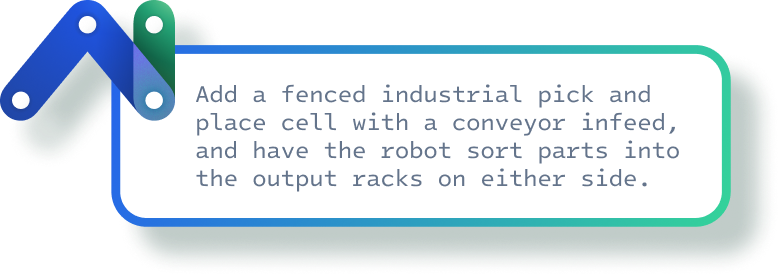
In the design phase, users can generate a cell layout with Agentic AI by describing it in plain language. Generated layouts map directly to Vention’s hardware catalogue and can be validated via Automated Design Checker. Once validated, the layout is immediately orderable with transparent pricing.
2. It Validates in Simulation
Agentic programming easily redirects to a digital twin for simulation. This ensures programs are tested and collision-free before they go live on the floor.
3. Agentic Monitoring Expedites Maintenance and Troubleshooting
Agentic AI, built on an open, cloud-based Python platform, can easily gather machine logs and sensor data to diagnose issues and propose fixes. Teams can also surface analytics with simple prompts like “Which production line had the most downtime last week?”, reducing the need for dashboards and convoluted reports.
4. Programming Outputs are Consistent
AI-generated code is always consistent and auditable. Agentic programming always follows the same logic, which increases reliability and reduces human error.
Reducing Trial-and-Error: Where Physical AI Comes in
Conventional automation means manual programming, a common bottleneck in production. But with Physical AI, robots can learn, adapt to, and repeat tasks like bin picking and kitting autonomously.
Modular pipelines like Vention’s GRIIP can sense depth, segment parts, estimate poses, and pick with greater accuracy. Because they act on their own with millimeter precision, the trial-and-error that comes with old, static robotics is lessened. Physical AI consequently automates historically manual-only automation work, much like Agentic AI.
The Costs of an Imprecise Automated System
Automation errors can happen in numerous ways thanks to imprecision, and the biggest mistakes often happen during commissioning or after deployment. But regardless of where or how they show up, they’re costly.
Without real machine context, AI tools generate generic outputs that still require heavy technical input and expert validation. Errors discovered during commissioning cause delays, rework, and cost overruns. Generic AI code generation, lacking machine context, also requires time-consuming rework. Errors that surface post-deployment require meticulous diagnostic work, pulling engineers onto the floor to interpret logs manually.
At every handoff, inconsistencies can compound. Not only does this impede uptime, but it also slows time-to-value and blocks future scaling.
An AI Investment is a Growth Investment
Sticking with outdated automation may be the simpler route. But inconsistencies, errors, and imprecision all add up and impact your bottom line. By using an end-to-end AI-Defined Automation Platform, not only do systems become accessible and standardized, but they open the door to bigger-picture growth.
Learn more about AI-Defined Automation with our new guide.