AI is likely a fragmented part of your automation workflow today. Many teams use it as an add-on for seemingly faster analytics or a search engine for simple coding questions. But AI’s impact often stops short of meaningful work.
But in the newest era of automation, the intelligence is more hands-on. Here’s what AI-Defined Automation can do, how it works, and what to look for in an effective, scalable solution.
What Is AI-Defined Automation?
AI-Defined Automation is a method of building, deploying, and monitoring automation in industrial spaces. Each layer of the stack is rich with artificial intelligence, enabling automation for historically manual-only tasks. This thereby automates the automation process.
The goal is to speed up deployment times, repurpose engineering and operating resources, address the labor gap, and make automation accessible to a broader team. It’s the most efficient era of automation yet, without compromising reliability or precision.
AI-Defined Automation combines Agentic and Physical AI. On the agentic side, automation designs itself by embedding AI into each stage of the workflow. For example, users can write plain-language prompts to design a cell or generate production-ready code.
On the physical side, robots and machines use sophisticated models to sense what’s in front of them, decide how to reach it, and then take action. Perception, motion, and control run as one pipeline, rather than via several separate vendors stacked together. The robots perform unpredictable tasks with precision, while adapting to the variability of the real world.
Not only does AI-Defined Automation make current projects more effective, but it also allows manufacturing teams to design, program, deploy, operate, and replicate future projects with ease.
Why AI-Defined Automation Is Emerging Today
The industrial space is seeing an AI-Defined Automation boom thanks to advancements in tech and rising market demand. More specifically, reasons to lean into AI now might include:
- Agentic AI in automation crossing the deployable threshold
- A worker shortage and the demand for labor-intensive roles
- Time and cost pressures rising while commissioning windows shrink
Plus, a faster time to ROI. The latest advancements in AI take automation projects from concept to concrete at unprecedented speeds.
Two Layers of AI-Defined Automation
Agentic AI
Agentic AI brings the intelligence to the automation of the cell. Users can design a cell or diagnose operational issues with plain-language prompts, and generate production-ready code in minutes. The ease of using a popular LLM tool like Claude or ChatGPT now translates into an automation context.
The workflow is then faster, more intuitive, and less prone to human error. It’s AI that does meaningful work, rather than providing a shortcut to a microtask.
Physical AI
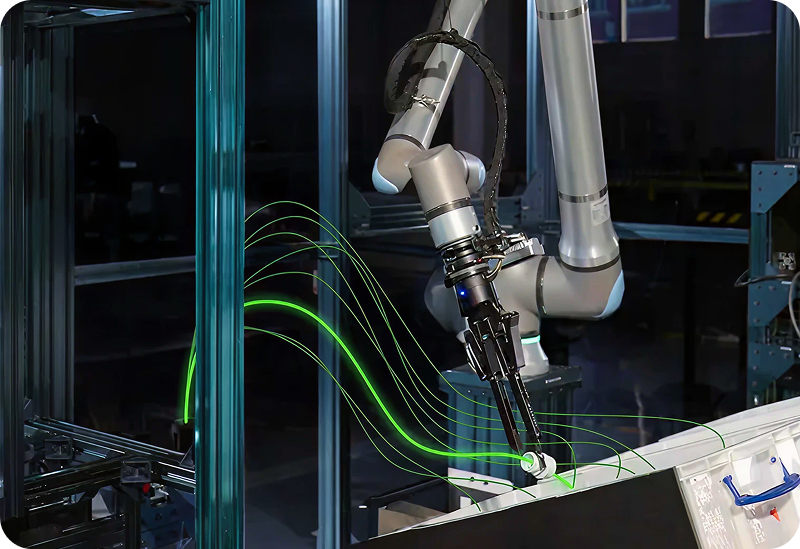
Physical AI brings intelligence to the robots on the factory floor. Picking technology used to be rigid because it needed a structured infeed. If a pick failed, the action halted. But with advancements in Physical AI, pipelines like Vention’s Generalized Robotic Industrial Intelligence Pipeline (GRIIP) adapt to unpredictable conditions and retry the action. The robots can sense depth, segment parts, estimate poses, and pick objects with greater precision than before. This not only improves pick success rates, but also automates things that previously couldn’t be automated.
Conventional configuration and manual programming were once a bottleneck in production. But with Physical AI today, robotics can learn, adapt to, and repeat tasks autonomously and reliably.
The Old World of Automation vs. The AI-Defined Era
Automation has advanced further in recent years than it has in the last few decades. Here is a breakdown of where automation was, where it is now, and what to expect in the near future.
-
The Hardware-Defined Automation era: This is what could be considered the “old world” of automation. In this era, tooling and programming were segmented. Hardware design, controller programming, and deployment and commissioning were very long and unpredictable. Engineering resources were strained.
-
The Software-Defined Automation era: This is our current world, and one in which many of today’s factories run. Most automation products are individual browser-based software tools for designing, programming, and monitoring. But with end-to-end software tools, teams unify these processes and speed up the project lifecycle. System integrators can also better standardize and scale automation projects. The result is increased productivity and speed to ROI.
-
The AI-Defined Automation era: This is the coming era in which the most advanced industrial automation platforms offer an even simpler, more accurate, and faster way to automate. AI is embedded into each layer from design to deployment (and beyond), and will mobilize manual parts of the workflow with new means of automation. It will also be made accessible to teams without the engineering expertise.
The choice to invest in the latest era of automation is one that bears consideration from both an efficiency and competitive standpoint. Those with AI-defined systems will find their payback times shorter than before, plus an advantage over the competition that simply can’t keep pace with their production.
How AI-Defined Automation Works
1. Designing
Teams can describe an automation cell in plain language and watch AI shape it as described. It can select predesigned cells, like the ones in the Vention library, and apply them directly to an open design without CAD experience. In the near future, the goal is to advance the software further to connect the selected cells and bring the configuration process down from hours to minutes.
2. Programming and Deployment
With AI-Defined Automation, teams can use Agentic AI to describe motion logic in plain language and generate the code instantly. There’s no local setup required.
There are also options available for teams that prefer working locally or need more programming precision. In these cases, an AI agent can be run in a local IDE. Once provided with the project requirements, the code will come context-rich, highly detailed, and production-ready.
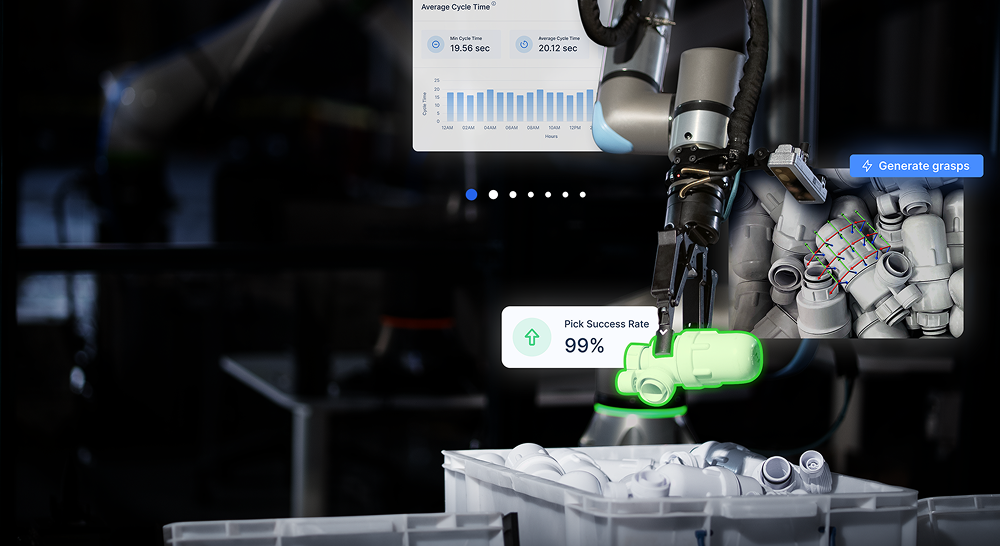
If using Physical AI, Vention’s GRIIP is a reliable solution to add to any cart. It’s a pipeline that powers robots and machines out of the box. By onboarding parts via a CAD file, users can deploy robots that perceive and segment items, estimate poses, grasp, and plan a collision-free path for a successful bin pick.
3. Operating
On the operational level, Agentic AI can be baked into analytics and troubleshooting. Analytics queries as simple as “Are there any downtime patterns across sites?” are actioned within seconds, generating an output that provides the user with complete visibility into whatever they need.
On the troubleshooting side, AI gathers machine logs, identifies cable or sensor issues, and diagnoses faults. Users can then make a suggestion or rewrite the code to get back up and running.
If a user has a Physical AI (GRIIP) setup, the robots can automate historically manual parts of the workflow by perceiving and adapting their actions in real time. They can then perform a variety of unstructured, unpredictable tasks, handling the variability of real production conditions of each cycle. Deep bin picking, pick-and-place, kitting, depalletizing, sanding, and machine tending are all common use cases made possible by the GRIIP’s pipeline.
4. Scaling
Physical AI makes scaling automation easy by means of out-of-the-box replication through Vention. Because machines learn and adapt to real-world conditions on their own, future projects are never truly net new. Projects powered by the Vention platform can be standardized and repeated without compromising precision.
What to Look for in an AI-Defined Automation Platform
Much like with any product category, no two offerings are the same. For those evaluating AI-defined solutions, features like end-to-end automation and digital twin validation are key. Additional technical requirements may include:
- AI-Assisted Cell Design
- AI Code Generation
- AI Diagnostics & Troubleshooting
- MCP or CLI, and Open SDK
- Robot-Agnostic Ecosystem
- Accessibility to Non-Experts
- In-Platform (no external tools required)
- Browser-Based Source of Truth
- Physical AI Solutions
Looking Ahead
So who is the AI-defined approach suited for? The reality is, it’s ideal for any manufacturing team looking to standardize automation, reach faster payback times, and automate parts of the workflow that were impossible to before. In a market where the competition moves fast, AI-defined Automation moves faster.
AI-Defined Automation FAQ
What Is AI-Defined Automation?
AI-Defined Automation is a means of automating the automation process for factory floors. Artificial intelligence is embedded in each stage of the workflow via platforms like Vention’s.
Which Types of AI Are Used in AI-Defined Automation?
AI-Defined Automation combines Agentic AI and Physical AI in various stages of the automation workflow.
Who Uses AI-Defined Automation?
Manufacturing teams close to the automation process benefit most from AI-Defined Automation. With plain-language design, programming, operation, and monitoring, it is made accessible to those without the engineering expertise.
What Are the Consequences of Not Using AI-Defined Automation?
The consequences of not automating in an AI-defined way could include losing an edge over the competition, more human error, increased downtime, and slow automation deployment.
Which Types of Businesses Offer AI-Defined Automation?
Vention is the only end-to-end solution on the market offering AI-Defined Automation today.
To learn more about how your team can leverage AI-Defined Automation, talk to an expert.