At CES 2026, Nvidia CEO Jensen Huang said we had entered the “ChatGPT moment for Physical AI”. Agentic AI was also a trending topic at the convention, and both have garnered hype in the industrial automation space. But these technologies mean nothing if the functionality is nowhere near being factory-ready.
Luckily, Physical AI is ready to clock in, and combined with Agentic AI, a new era of AI-Defined Automation is here. In this article, we’ll uncover the advancements in Agentic and Physical AI for manufacturing, where the technology is already reliable, and 5 reasons why 2026 is seeing the biggest AI boom yet.
Digital AI vs. Physical AI in Manufacturing: What Scaled First
Moravec’s Paradox observes that it’s easy to train AI to carry out high-level intellectual tasks like math problems, strategy building, or playing chess. But when it comes to motor skill tasks that come naturally to most humans, technology struggles to nail the basics.
In an automation context, the paradox rings true. Initially, AI was used around the plant in planning, finance, and CRM contexts, as these software-defined use cases were the first to emerge. AI automation on the factory floor itself took longer, since automation is based on physical tasks and digital AI is largely about pattern matching.
In recent years, Software-Defined Automation began digitalizing factory floors. This was the base for digital AI to develop, and it started to emerge in phases of automation project lifecycles, like AI-powered analytics or design suggestions.
Physical tasks like grasping, carrying, and adapting to a misaligned part are much more complex, requiring real-world perception and a level of reliability that took much longer to reach. The newest wave of digital AI, Agentic AI, was last to hit factories, as it supports autonomous functionality like describing cells in plain language and receiving a shippable layout instantly.
Where AI Already Delivers
You likely already use digital AI, and maybe even Physical AI in your day-to-day in manufacturing. Predictive maintenance and design suggestions are common AI applications, and according to Businesswire, 72% of manufacturers have adopted AI in some form, up from 53% in 2024. Recent innovations in the IndustryTech space include:
- Design. AI-powered CAD platforms design automated equipment and robot cells in minutes. Agentic AI can take you from concept to build, taking price, parts, and logistics into account along the way.
- Programming and deploying. Whether it’s one robot arm or a complete robotics application, AI can accurately take an imagined design all the way to deployment by programming in plain language. Physical AI also reduces traditional robot programming. Computer vision detects and segments objects, computes optimal grasp points, and generates collision-free motion paths automatically, no code required.
- Operating and troubleshooting. With one AI-driven automation controller, users can operate sensors, motors, and robots remotely just by asking their AI agent. Once running, robots can also perceive and adapt in real time. They handle the variability of production conditions on every cycle, running lights-out with minimal human supervision. New parts are then onboarded autonomously.
- Scaling: Every deployment feeds the data flywheel. Field data from production strengthens the models over time, and a proven cell can be replicated across lines and sites without starting from scratch.
When we combine the digital AI we already know with advancements in Agentic and Physical AI, the manufacturing space scales further and faster in a new era of AI-Defined Automation.
5 Reasons AI-Defined Automation Is Landing on the Factory Floor in 2026
1. Agentic AI Has Crossed the Deployable Threshold
Businesses leaning into automation and robotics know that systems that only work 70% of the time won’t cut it. Thankfully, with the right context and tools, Agentic AI performs more consistently and reliably than before.
Foundation models, AI pre-trained on massive datasets, can now interpret niche industrial requirements and autonomously create automation code. This takes the technology from concept to concrete. Early adopters are seeing results like a 95% reduction in data query time and 80% automation of transactional decisions.
This creates outputs that are consistent, auditable, and less prone to human error. Every generated program follows the same logic, and fewer engineering resources are used. The Agentic AI market as a whole reached $5.5 billion in 2025 and is expected to grow at 25% CAGR to reach $16.8 billion by 2030.
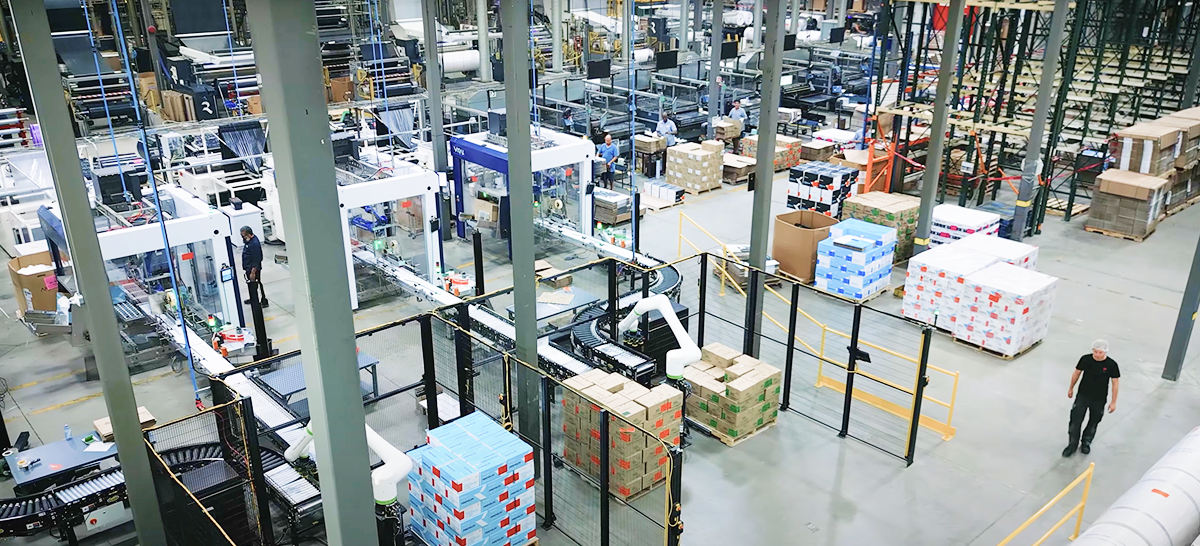
2. The AI Running the Cell is More Capable than Before
Many factory floors treat AI as an add-on to suggest parts, check errors, synthesize data, and sharpen forecasting. Today, it can go even further by being built directly into the controller that runs the cell, making real-time decisions that move the hardware itself.
MachineMotion AI is one example of AI built at the controller level. Powered by NVIDIA Jetson and the NVIDIA Isaac CUDA-accelerated libraries, it delivers the processing power to perform Physical AI tasks like real-time vision processing, bin picking, and autonomous decision-making. This makes the AI a part of how the cell runs, not a support function bolted on after the fact.
3. The Labor Gap Remains
The median age of manufacturing workers is roughly 44.3 in the U.S., meaning an accelerating wave of retirements will outpace young trainees entering the workforce. Recruitment and worker upskilling are common strategies to top up headcount, but deploying Physical AI and robotics to handle some labor-focused tasks is proving more future-proof as recruitment and retention remain uncertain.
Agentic AI also plays a part in filling the labor gap. 62% of planned automation projects are already delayed 6 months or more due to a lack of engineering expertise, according to 3HTi. With Agentic AI steering itself, any team member can design, program, and operate automation without needing deep technical expertise.
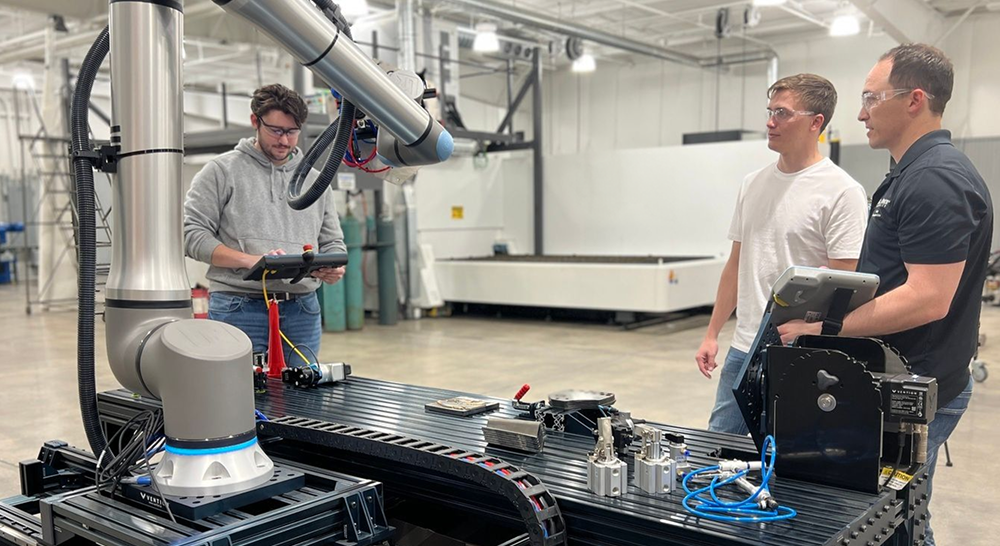
4. Time and Cost Pressures are Rising
Today, integration and controls make up roughly 30-40% of total automation project costs, and commissioning a robotic cell on-site takes between 2 and 6 weeks. This is time that most engineering teams do not have, and implementation and labor costs that executives need to account for.
By using AI-Defined Automation and virtual commissioning, teams can reduce on-site time significantly. Deployment times go from months to weeks, and uptime is more consistent.
5. The ROI is Undeniable For Mid-Market Manufacturers and Beyond
75% of teams already report measurable ROI in under six months of adopting Physical AI on the factory floor, according to MaintainX’s State of Industrial Maintenance report. But it’s worth noting that adoption alone won’t mean reliability. 79% of teams also saw unplanned downtime in that period.
End-to-end systems built on AI-Defined Automation principles are key here. Agentic AI delivers lower project costs and shorter payback periods, and meaningful Physical AI ROI is in the functionality, discipline, and replicability across systems, not in adoption for the sake of checking a box.
The Next Era of AI is Physical and Agentic
2026 may not be the year that AI first landed on the factory floor, but it is the biggest year yet for adoption and deployment. To make technological strides in their sector and stay competitive, it will be a non-negotiable for forward-thinking businesses.
Learn more about Physical AI in industrial automation with our latest whitepaper.