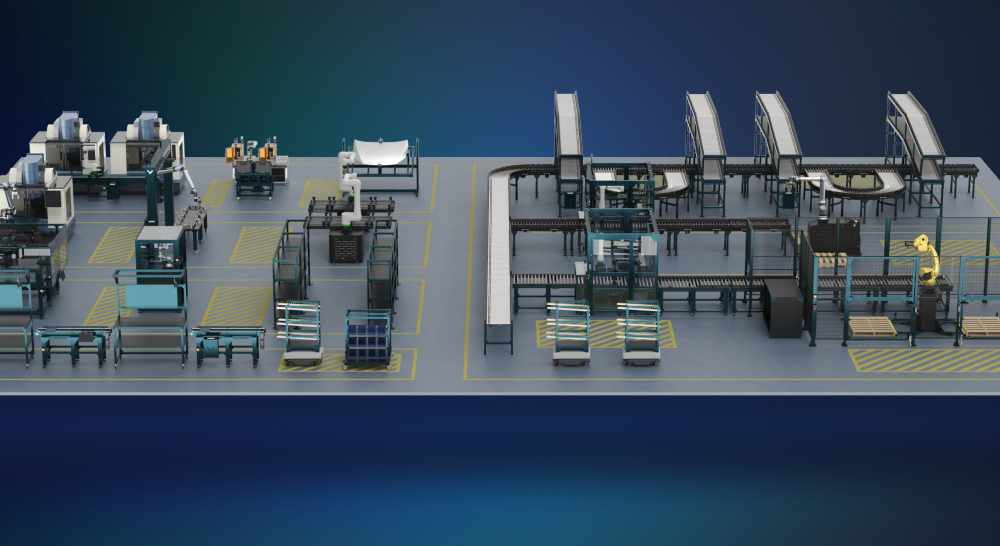
Data center manufacturing has quickly become one of the fastest-growing sectors in the last decade. With that comes greater manufacturing demand. From server racks to CPUs, data center parts factories are trying to scale up production globally.
While keeping pace with demand is a challenge, it’s not an insurmountable one. Here, learn the phased approach to factory expansion for data center manufacturers, including what to automate first and things to consider during implementation.
Data Center Equipment Demand Today
Research from McKinsey shows that data centers are projected to require $6.7 trillion globally by 2030 to meet rising demand for compute power. That means builders need more infrastructure, more headcount, and more parts. Manufacturers, according to Woodmac, currently struggle to expand capacity, with lead times for some equipment reaching 18-36 months.
Ultimately, it’s these equipment constraints that dictate the pace of new project development. And for many, increasing production means overhauling the lines completely.
Why New Plants Aren’t Enough
For the biggest players, a common strategy is to build. But the fastest new plant construction still takes months. In March 2026, Vertiv announced a $50 million investment to expand factory operations in Ohio with projected completion mid-2027. Eaton, a global energy management firm, also announced a $30 million investment in April, only to announce they’re breaking ground in 2027.
The point remains that to increase production and output, businesses of all sizes could benefit from automating and streamlining the systems already in place. Here’s what that looks like in practice.
4 Phases For Scaling Data Center Equipment Production

1. Identify Underperforming Processes
Step one is diagnosing which areas of production are most inefficient. Bottlenecks may include:
-
Manual stations that require one or two skilled technicians to operate
-
Material moving by hand down the line
-
Extensive manual parts testing that stalls shipment
-
End-of-line packing that fails to meet the pace of upstream production
A few stops on your production line likely require highly skilled labor that many factories simply don’t have. According to Manufacturing.net, switchgear and power system assembly alone requires technicians who understand both automation and electrical work. That’s why identifying areas where technicians can move from manual work to higher-value tasks is critical.
2. Start With Stations and Material Flow
When it’s time to streamline the line, material flow and manual stations are the easiest starting points. Ergonomic workstations and purpose-built carts and conveyors are a fast way to either add a new line or double down on a busy one.
Kitting carts, for example, can store liquid cooling manifolds, and mobile carts can better carry heavy subassemblies between switchgear stations than moving them by hand. Before improving all material flow and stations, however, it’s important to standardize. When one process or station is proven and well-designed, it becomes an effective blueprint for the rest.
3. Automate Quality-Critical, Repetitive Tasks
In phase one, you identified your biggest bottlenecks. Now is the time to automate on a cell-by-cell basis. Just like in phase two, the key is to automate and prove one cell and repeat across lines. Entry points to automation might include:
-
Bin picking: Physical AI systems can automate part picking and placing, reducing the need for workers to manually pick at the cell.
-
Conveyors: These link standalone stations into an evenly paced assembly line.
-
Test cells: Setting up cells to test delicate PCB boards or other parts increases production and upskills technicians.
4. Automate and Scale End-Of-Line
When upstream production increases, the end-of-line becomes the next bottleneck. Manual palletizing, packaging, and shipping hits cable, fiber, and connector plants particularly hard.
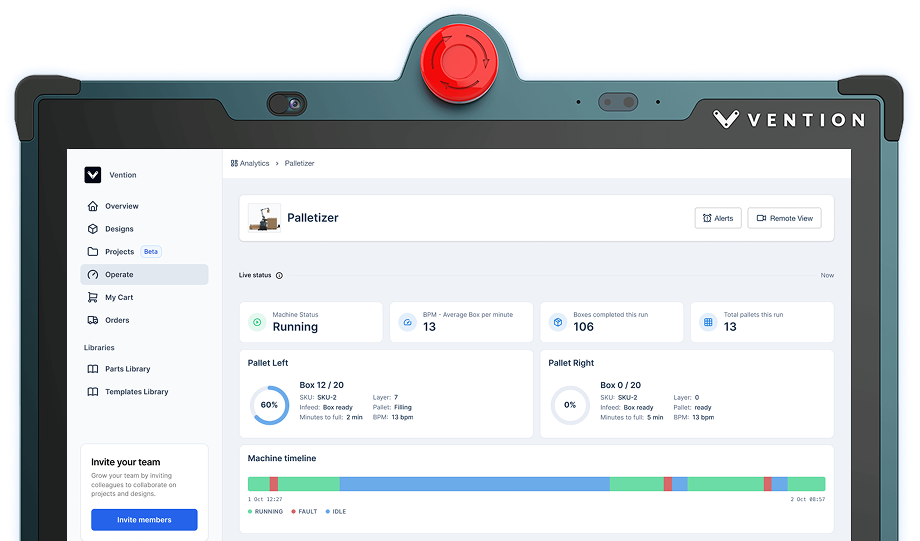
Robotic palletizing is becoming the new norm for many factories, and data center manufacturers could reap the same benefits. For Vention systems, palletizing cells can run in tandem with conveyors, buzzers, towers, and analytics tools. This means quick pivots when production needs change, and faster troubleshooting thanks to increased visibility. User-friendly, customizable palletizing systems also reduces the number of operators required at the end of line.
Focus on Volume and Flexibility
Expanding for higher volume production is ultimately the goal. But when SKUs churn, production needs flip, and new products skyrocket in demand, it’s also important that the systems you introduce are adaptable.
Data center hardware can change quickly. New rack generations, more advanced cooling equipment, and completely new power architectures could easily reshape equipment needs. Modular, reconfigurable equipment protects your investment when your production lines make a hard pivot.
The Full-Stack Phased Approach Wins
The answer to slow data center manufacturing is a planned, phased approach. The factories that automate existing systems with a full-stack solution, as opposed to waiting on new construction, are the ones most likely to find success in the industry.
Learn more about automation readiness with our Automation Maturity Assessment