About 40% of new SKUs are no longer bought two years after launch, according to a Marketing Letters study.
For factory floor managers, that turnover creates uncertainty when scoping packaging end-of-line automation. A new SKU means potential changes in the case size, weight, and patterns a palletizer has to handle. This is the fear that weighs on buyers: putting money on a solution they’ll outgrow before it pays back.
Traditional cells were designed for predictable lines. Any change meant bringing engineers back in to reprogram and redesign. This approach made flexibility costly and lengthy. Alternatively, cells designed to be flexible from the start often came at the cost of throughput and reliability.
Software-Defined Automation moves the logic of a machine out of fixed hardware and custom code and into a single software platform, where design, programming, simulation, and operation stay connected. With everything in one place, every part of the cell is accessible digitally.
Vention provides that access in the browser through its platform for custom applications, and on the pendant through MachineApps for turnkey solutions like palletizers, conveyors, and AI-powered applications. Because MachineApps run on the same platform that designed and programmed the cell, they are intuitive and complete enough to move SKU changeover work from engineering to configuration. When conveyors, palletizers, and controls run on one platform with one brain, adding a new SKU becomes an intuitive task that can be done entirely within MachineAPP on the pendant, as simple as adding a new recipe.
What matters then is knowing how factory changeovers actually work, what a cell can absorb, and its physical limitations. This allows us to scope for any product today, any change tomorrow.
What Changes When the Product Changes?
Imagine a manufacturer wins a private label contract. Within a month, the retailer asks for a new pallet pattern for its distribution centers and a multipack format for its club-store banner. Both get labeled “product change,” but they’re different events. One changes how the same case is stacked, the other changes the unit coming down the line. Neither changes the product itself. Neither requires a new scope, a redesign, or a deep dive into the cell’s program either.
In general, product changes fall into three types, and most of them can be handled directly in MachineApp.
- A new pallet pattern: The case stays the same. Only the stacking order changes. On a robotic palletizer, this is a configuration task in MachineApp.
- A new case or bag format: A multipack, trial size, or switch in bag materials, for example, falls under this category. This is the most common type of product change. In fact, an early 2024 study shows 65% of all global launches in Consumer Packaged Goods (CPG) were renovations of existing products. This remains a configuration task in MachineApp. New case dimensions, weight, surface, and stacking patterns can be added as a recipe in the pendant, only limited by the cell’s physical ranges.
- A genuinely new product: A new product can change case weight, size, or the number of cases the robot picks per cycle. Whether the existing cell can absorb it depends on the headroom built into the original scope. If cases go from 22 lb (10 kg) to 44 lb (20 kg), a cobot rated for 66 lb (30 kg) can still handle them, often with a gripper swap and a new SKU recipe. Changes that exceed the cell’s payload, reach, or speed, such as doubling throughput, are the ones that send the line back to engineering.
This is where scoping does the real future-proofing work. Production growth is hard to predict, but the cell’s operating envelope is a choice. Sizing the robot for the heaviest product on the roadmap, rather than today’s, and specifying tooling for the formats you expect to run keeps most future changes in configuration territory. One global beauty manufacturer took this approach, purchasing three grippers up front to cover every format across its production lines, so introducing a new product means swapping a tool instead of rebuilding a cell.
| Type of Change | Pallet Pattern | Case or Bag Format | New Product |
|---|---|---|---|
| Where it lands | MachineApp configuration | MachineApp configuration, sometimes gripper or guides | MachineApp configuration, possibly hardware |
| Who handles it | Operator | Operator. May sometimes require remote support. |
If the new product remains within payload and throughput range, operator. If the new product exceeds the cell physical limitations, application engineer |
In practice, pallet patterns, case formats, and most new products come down to recipes that operators can add or adjust directly in MachineApp: updating case dimensions and weight, generating a pattern, and previewing the build before it runs. None of it calls for a new scope, a redesign, or reprogramming.
It is only when the physical limitations of the cell are exceeded that a palletizer with a Software-Defined approach needs to be redesigned or rescoped. This can be prevented from day one, by scoping payload, reach, and throughput for the products on the roadmap and potential evolution instead of just what is in production today.
How Many SKUs Can a Palletizer Handle?
Vention palletizers feature unlimited SKU capacity. Each product and pattern goes in as a recipe into a growing library. With no fixed limit, there’s no need to delete older SKUs to make room for new ones. This accelerates production for seasonal SKUs or return runs.
Without a cap, adding SKUs is easy. Motion is harder. Many robotic cells require teaching motion by waypoints. Taller cases or new layer counts then need to be re-taught new paths and collision checks. Environment-aware path planning solves that issue.
With environment-aware path planning, the cell knows where conveyors, fencing, and adjacent equipment sit, planning collision-free movement around them. Even when third-party equipment is involved. A new recipe comes in, the cell takes care of the rest.
Can Operators Change a Palletizer Recipe Without an Engineer?
A cell with unlimited recipes adapts only as fast as someone can create them. Bringing in an engineering team every time a new SKU is added is simply not fast enough, potentially not even feasible. Deloitte and the Manufacturing Institute project that 1.9 million US manufacturing jobs could go unfilled through 2033, with engineers and maintenance technicians among the fastest-growing roles. This is why usability and accessibility are key to automation success.
Vention palletizers ship turnkey, with the existing scope already programmed and set up. From there, MachineApp gives operators an intuitive interface on the pendant to adjust existing SKUs and add new ones. Operators can simply enter the case dimensions and weight, choose or generate a pattern, and preview the build before it runs.
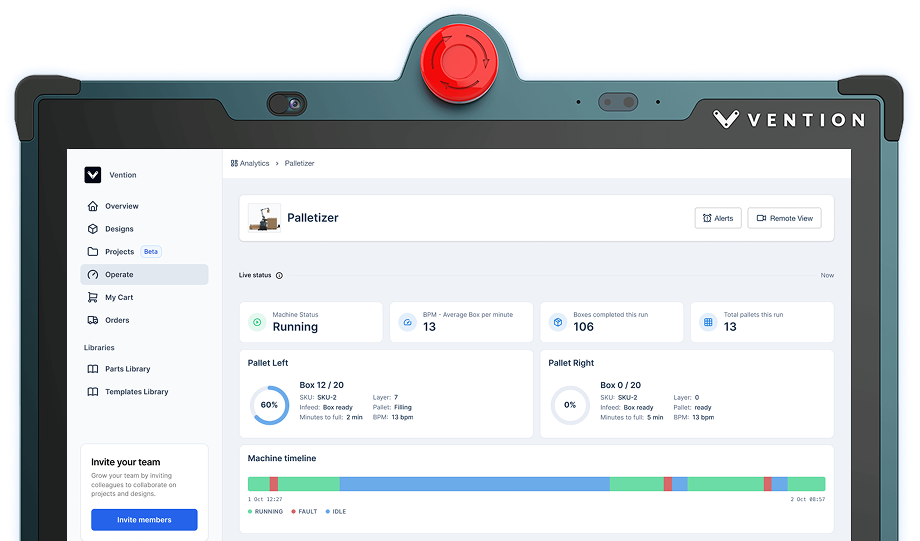
Concurrent apps let operators switch between palletizer and conveyor applications on one pendant, with a dedicated app for each machine so they can monitor each one’s behavior, and tower light and buzzer behavior can be set to match the production line states.
Polykar, a Canadian packaging manufacturer, replaced labor-intensive manual palletizing with two FANUC CRX cobot palletizers, each with a dual infeed handling multiple SKUs. Output increased by an estimated 30%, with CEO Amir Karim crediting the project with better employee satisfaction and retention as well as more predictable production runs.
How Do You Scale Palletizing Across Lines and Plants?
Scale is another way plants outgrow a palletizer.
With rising volume demand, the most efficient way to scale is to build on what is already installed and working: a second infeed, a second palletizer on shared conveyors, or extended conveyors.
When everything is built as one system under one platform, expansion is virtually plug-and-play. New equipment simply needs to connect to existing systems instead of going back to the drawing board for an integration project.
This approach remains the most efficient for scaling across plants. When a cell is repeatable, multi-site manufacturers can save the engineering costs and guesswork that come with starting from scratch. Design, recipes, operator experience, and even spare parts can carry over between sites.
This was how Polykar duplicated its Edmonton systems at its Montreal facility. Replicating success without the need and cost of redesign
Addressing Physical Limitations: Cobot vs. Industrial Palletizer
MachineApp can absorb new products, patterns, and formats. It cannot, however, make a robot move faster or lift heavier than it’s rated for. Therefore, payload and throughput (or the weight brackets the cell will handle) must be decided before the cells come in.
To achieve flexibility here, payloads must be considered as a range. What’s the heaviest case you expect to run, and what type of grippers will cover the highest percentage of your cases? Industrial robots can carry heavier loads and move faster than cobots, but cobots cover much more than buyers often expect.
Vention’s Rapid Series Cobot palletizer can handle up to 66 lbs and 13 picks per minute. Heavier loads move to Vention’s industrial palletizers, which support multi-pick and can handle up to 300 lbs, reaching as much as 80 units per minute.
Because cobots share the space with people, their speeds are defined by risk assessment. Industrial robots, on the other hand, run at full speed inside guarded cells. With both options available, the right choice depends on payload, throughput, and factory conditions.
Starting with a cobot also keeps the industrial option open. If volumes outgrow it, an industrial palletizer can join the same system and communicate with existing equipment just as seamlessly, while the original cobot is repurposed for another task on the floor.
Buying for the Portfolio
Most palletizing project concerns are sparked by asking what happens if production changes. A better approach, instead, would be to assume that it will.
A palletizer that works only for a specific product, or specific throughput, bets on the mix staying still. One designed for a portfolio of items, with headroom for payload and throughput variations, an unlimited SKU library, and operator-run changeovers, treats change as part of the routine work the cell was designed for.
To learn more about future-proofing your investment, talk to a Vention expert and scope a design that will grow with you.