.png)
At the end of the production line, nailing the palletizing process is no small feat. The manual method has served countless teams well over the years, but with labor shortages and demand for quick shipping greater than ever, it’s unreasonable to expect fully human-powered teams to keep up at scale.
The answer, then, is to automate. Both collaborative robots (cobots) and industrial palletizers are popular choices, but it’s difficult to know which machine is better for which use cases. In this article, we’ll detail when to choose the cobot, when to choose an industrial palletizer, and the myths behind automated palletizing that might push your results in an unexpected direction.
What is An Automated Palletizer?
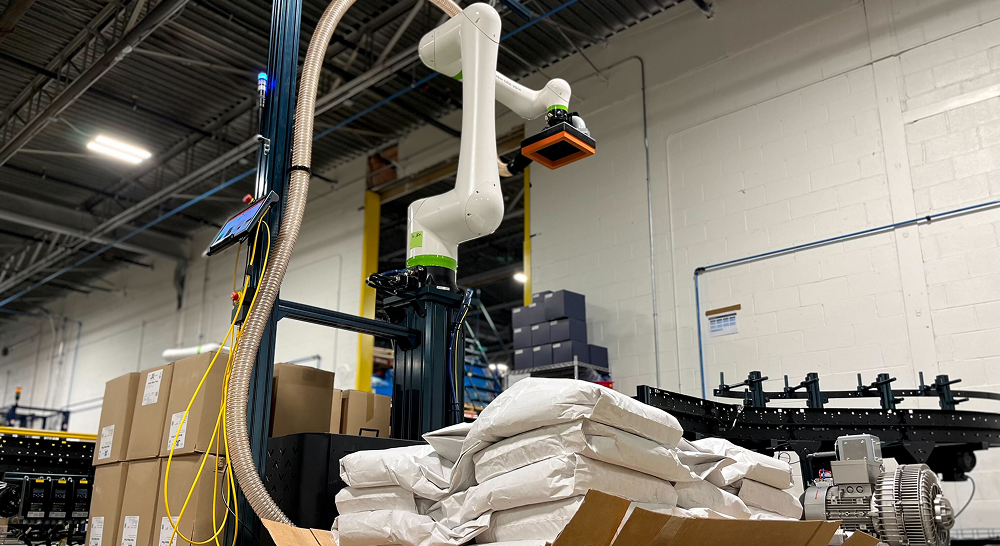
An automated palletizer is a robot that replaces manual box, bag, and package stacking. An integral part of every production line, automated palletizers use robotic systems that lift and stack product repetitively and autonomously. The process includes picking an item off an infeed conveyor, placing it in a stable position, and building up the pallet according to a predetermined pattern.
There are many types of automated palletizers with varying capabilities. But across configurations, the core functionality is the same. They turn inconsistent, costly, injury-prone manual work into scalable systems that power themselves.
What Separates a Cobot from an Industrial Palletizer
Cobots have an industry reputation for being the safer, more user-friendly option. Designed to work alongside (collaborate with) humans, cobots don’t require bulky safety fencing when set at collaborative speeds, and come with a smaller footprint than many counterparts.
Industrial robots, on the other hand, have a reputation for being more complex and only suited for the largest enterprise-grade factory floors. Yes, they can work faster and lift heavier than cobots, but that doesn’t mean they aren’t safe or simple enough for small to mid-sized factories. In cases like Vention’s, both industrial and cobot palletizers meet in the middle with similar safety features and the same user-friendly interface.
Here’s where both machines stack up head-to-head in three key categories.
1. Payload and Throughput:
Throughput requirement, or how many items must be palletized per day, is a significant factor when evaluating automated solutions. Although they do have similar cycle times, industrials have a slightly higher “per-minute” throughput rate than cobots. The largest industrial robots can handle entire pallets every minute.
As for payload, cobots can pick up a box up to 30kg and industrials can pick up 5 to 7 of them at once. It’s worth noting, however, that operating at the highest payloads will force lower robot speeds.
2. Safety and Floor Space
Safety is another common evaluation factor, and for good reason. With Vention, both cobots and industrial robots have similar built-in safety features, but due to the speed and weight that industrial robots can work with, they’re worth fencing off in many cases.
This may or may not be an issue in warehouses with limited floor space. When considering footprint, it’s important to not only calculate the size of the robot itself, but also the infeed conveyor, scanner placement, fencing, and the size of the final workflow in its entirety.
3. The Costs: Upfront vs. Long-Term
Like with any purchase, many businesses simply opt for the most inexpensive option. The time to ROI might seem shorter this way, but if you previously had four people manually palletizing, the ROI for an industrial robot to fill their place would be as fast as the ROI for the cobot you had your eye on.
Ultimately, the platform that can meet business needs now, but will scale for the future, is the most economical option. Consider speed to deploy, but also what your future throughput, monitoring, and expansion needs are in the coming months and years before choosing your palletizer.
When Multiple Cobots Beat One Industrial Robot (and Vice Versa)
A combination of throughput needs, floorspace availability, and scaling plans will determine the best solution for your team. And that result might not be what you had initially expected.
- If your team has high throughput requirements and ample floorspace, you may assume an industrial palletizer is the answer. Through deeper evaluation, you may find that your lighter packages and a high-traffic packaging area mean multiple cobots are a better solution. Sustainable packaging company Polykar recently deployed two cobots in both their Edmonton and Montreal facilities and saw a 30% increase in productivity.
- Many businesses have a team of operators for their production lines, and assume that a few cobot palletizers are the quickest way to reduce some of that dedicated labor. But businesses like Rev-A-Shelf show that industrial palletizers are just as simple to deploy. With their industrial palletizers through Vention, they were able to reallocate 8 operators to higher-value tasks.
An internal evaluation of your needs and setup is a great starting point, but connecting with the right experts will uncover factors and scenarios that may have been overlooked. The myth that cobots are too simple and industrials are too complex could also lead to under-spec’d systems. Course corrections after the fact could be costly, and committing to an improper setup to start with also means leaving money on the table.
The Palletizer Buyer’s Checklist
When it’s time to evaluate palletizing solutions, there are a few initial questions that are helpful to explore.
-
What is being stacked? Whether it’s boxes, bags, pails, or trays, the packages will determine gripper selection.
-
What are your throughput requirements? Items to palletize per minute could point you toward the right configuration.
-
What are some must-have pallet features? Slip sheets, fencing, an easy-to-use interface, and more will influence the best available options for your team.
Keep in mind that if you opt for a fragmented solution, it will involve separate buying processes with each vendor. To monitor or troubleshoot that setup, the point of contact to assist you may be unclear. That’s where end-to-end solutions like Vention help. By offering full-stack automation, each stage, from design to deployment to monitoring, is taken care of by one platform.
End-To-End Support Through Either Path
Cobots and industrial palletizers fit different use cases, but are ultimately both great ways to elevate manual operations and scale. Evaluating with care means partnering with your team and the experts, and could be the difference between an underspec’d system and the efficiency you’ve been looking for.
Not sure which palletizing setup meets your team’s needs? Take the palletizer complexity quiz.