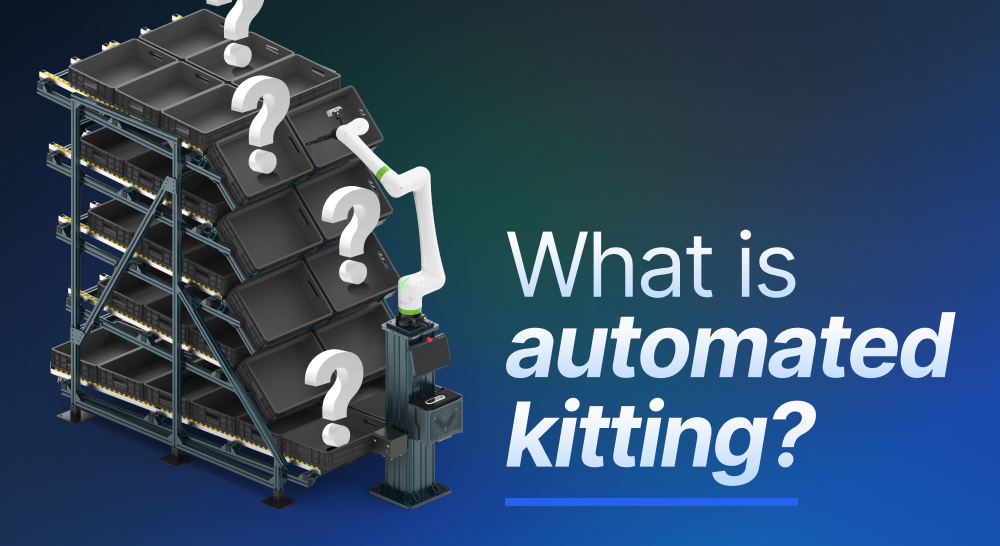
At most factories, setting up a worker at a manual kitting cell is a given. These are trained employees with the dexterity to grasp, pick, and place for eight hours a day. Changing a system that works? It’s hard to justify.
But a system that is increasingly hard to staff, slow, and error-prone hardly qualifies as effective. That’s why the manual kitting challenges of today drive many factories to automate. Here’s what automated kitting is, what the value is, and which industries benefit most from a more autonomous approach.
What is Automated Kitting?
If you have kitting cells on your factory floor, you know that it’s a process of gathering parts for assembly and placing them in a single output container, or kit. When you automate that job, it means handing it over to a robot.
A vehicle’s side mirror, for example, requires glass, mirror housing, fasteners, clips, and wiring components. A robot picks each part and organizes it into the right output bin in a set sequence. Once kitting is complete, that bin is sent to the assembly line where either a robot or an operator uses the kit to put the pieces together.
Why Do Manufacturers Choose to Automate Kitting?
One of the biggest reasons to automate is the labor shortage. It’s not uncommon for an enterprise factory to need as many as 25 people at the kitting cells alone. Hiring is also slow, and retention is low across manufacturing. 65% of manufacturers name attracting and retaining labor as a primary business challenge, according to a study from Deloitte and The Manufacturing Institute.
Competition is often reason number two. Manufacturers across industries face pressure to produce more at faster rates and lower costs. Consumers and businesses alike expect production turnaround times to match the same-day speed of B2C giants like Amazon. Fast production is also often the difference between winning and losing the next big client.
Accuracy is the third most common reason to automate. Manual kitting is tedious, and while humans have the dexterity to do the job, it’s not without mistakes. A single missing fastener or an accidentally swapped part can stop the line or send a defect into assembly. A robot, on the other hand, follows defined recipes to complete picks with stronger precision and accuracy.
The Value of Kitting with Physical AI
Initial iterations of robotic kitting struggled because the task had to be highly structured, and each part and pick had to be individually coded. If a new SKU or robotic gripper was introduced, it also meant bringing an integrator and engineer to the floor to reprogram. That kind of downtime, especially for factories with frequent product changes, was costly.
Adaptable Physical AI solutions remove that friction. With Vention’s modular Physical AI pipeline GRIIP, for example, robots can perceive, segment, grasp, and plan a collision-free path for a successful pick. It operates with sub-millimetre precision, and if a pick isn’t perfect, the robot adapts and tries again. New recipes and parts can be onboarded via CAD files, and will soon be CAD-less, so the downtime created by calling on-site integrators is no more.
Advancements in Automated Kitting: How Far the Tech Has Come
The introduction of Physical AI has pushed automated kitting further this year than the last 10 years combined.
Pretrained perception and manipulation models give operations and engineering teams a stronger starting point, for one. Instead of building every robotic capability from scratch, the kitting workflow is broken into pieces to identify what the existing models can already handle, and minor gaps are developed from there.
End-to-end automation solutions take kitting even further. Vention is the only solution that supports every step of the automation project lifecycle. Powered by AI-Defined Automation, the platform uses both Physical and Agentic AI to better enable not just robotics deployment, but automation design, programming, troubleshooting, and monitoring. With it, Physical AI applications can also tackle unstructured tasks where conventional automation fails.
Which Industries Are Best Suited to Automate Kitting?
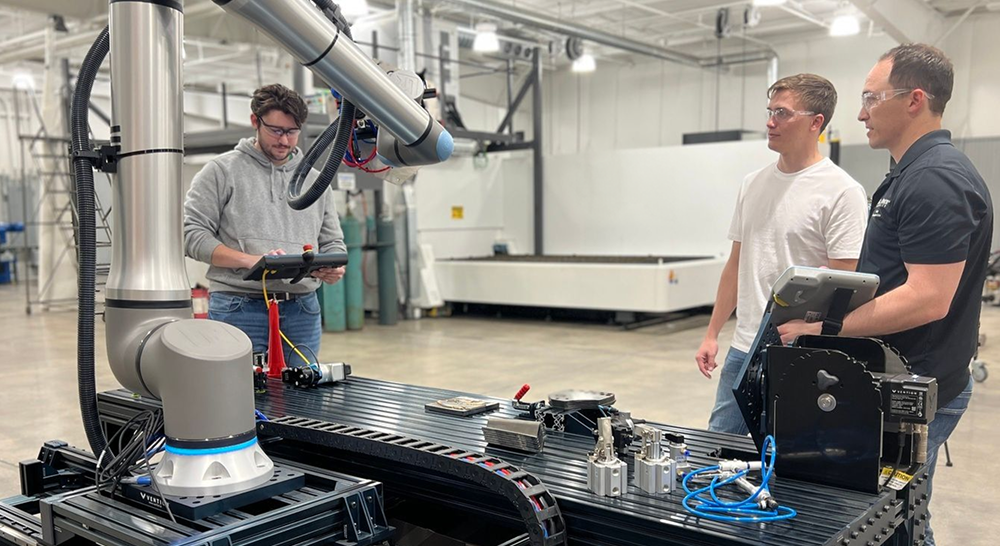
Automated kitting is presented most commonly in the automotive and aerospace industries. Vehicle and airplane assemblies depend heavily on a flow of multi-part kits that range in complexity. Additional sectors that benefit from automated kitting include:
-
Electrical equipment providers: A global power and electrification manufacturer kits components and boxes for circuit breaker assemblies.
-
Data Center manufacturers: Equipment assembly, large and small, is often kitted earlier in the line. This is one of the fastest-paced sectors, as data center infrastructure demand has never been higher.
-
E-commerce and fulfillment: General manufacturing and dropship enterprises like Amazon and Wayfair also benefit from automated kitting to meet same-day shipping demand.
In terms of company size, larger enterprises are feeling the most pressing need for automated kitting, as their cells are the largest and most difficult to staff. Once automated, robotic kitting cells upskill operators and engineers to positions like quality control, maintenance, and cell supervision.
Going Beyond Kitting
Manufacturers and factory operators who automate their kitting cells now are building on a more autonomous line for future scaling. With production pressure rising and labor gaps widening, the factories that move the quickest will set the pace the rest of the sector has to match.