Physical AI is moving from research to factory floors faster than most manufacturing teams can learn the terminology. Words like edge compute, sim-to-real, and in-hand localization now show up in vendor pitches and engineering meetings, while many stakeholders haven’t had a chance to clarify exactly what they mean.
This glossary breaks down the terms shaping Physical AI today, so you can better evaluate solutions and navigate the space with confidence.
The Physical AI Basics Explained in 6 Terms
1. What is Physical AI?
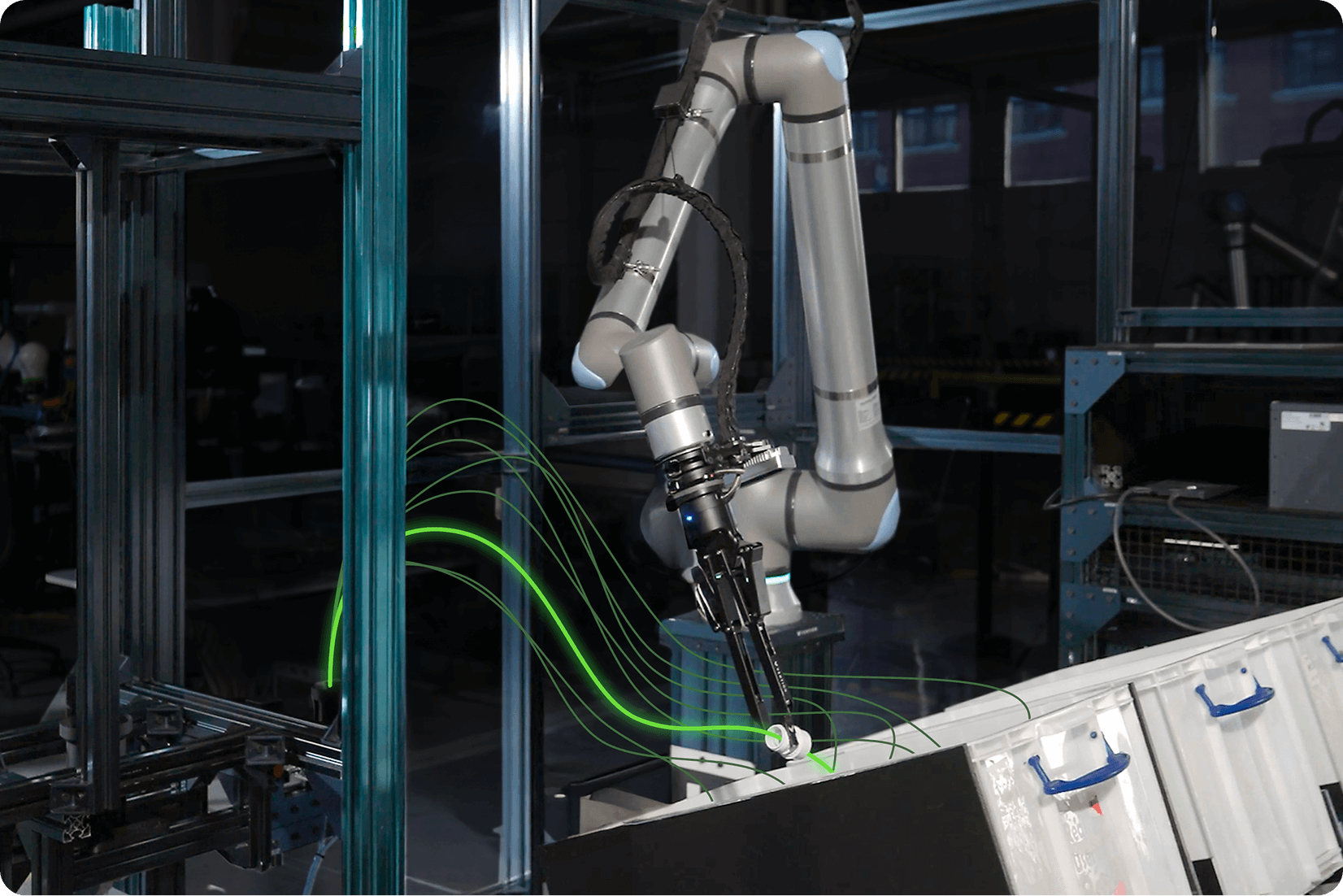
Physical AI is artificial intelligence embodied in machines that operate in the physical world. Conventional automation has parts and machines in fixed positions, so the robot always knows what to expect and how to perform an action repeatedly.
Physical AI, on the other hand, handles uncertainty. It can detect randomly placed parts, then decide where to grip them, and then plan a collision-free path autonomously. They also retry when a pick fails. In earlier, more limited forms, you may have heard similar functionality called vision-guided robotics.
2. What is an AI Pipeline?
An AI pipeline is a modular approach to building Physical AI. Sensing depth, separating parts, estimating orientation, choosing a grasp, and planning the motion are all separate steps. Each step runs a model specialized for that job.
If a better model is released for one step, only that component is upgraded. The rest of the system stays unchanged and intact. The pipeline approach uses proven, industrial-grade robots to deliver predictable cycle times, and is why the model has already hit production floors.
3. What is an End-to-End Model, or VLA?
The end-to-end, or vision-language-action (VLA) model, is the other approach to Physical AI. In this method, a single neural network takes in sensor data and plain-language instructions, and outputs robot commands without the intermediate steps.
These models better support highly dextrous, adaptive tasks, but their behavior is probabilistic and not deterministic. This means speed, repeatability, and safety certification are harder to achieve.
4. What are Sensor-to-Action Models?
This is where the AI pipeline and end-to-end approaches converge. The modular pipeline collapses into a unified, learned model. Sensor data goes in, and low-level robotic commands come out. This creates better dexterity. Hard-to-program behaviors, like nudging a jammed part toward the middle of the bin, are then learnable.
AI pipelines adopt sensor-to-action components incrementally, using today’s deployable architecture with tomorrow’s advanced dexterity. While a promising model in concept, the sensor-to-action model is not yet deployed on production floors.
5. What is a Foundation Model in Manufacturing?
A foundation model is an AI model pre-trained on massive, diverse datasets. The goal is to apply it to many prompts or tasks without needing to be retrained from scratch. Think of it as base knowledge, or prerequisite training.
In manufacturing, foundational models are why a modern system can recognize, separate, and locate parts it has never seen before, without weeks of collecting and labeling images of specific components to refer back to.
6. What is Imitation Learning?
Instead of explicitly programming a robot, imitation learning teaches manipulation skills via human demonstration. A person performs a task, the system records the example, and the model then learns to reproduce that skill.
It doesn’t mean the robot improvises or executes based on an assumption. Demonstrations are the only source of learning here. This is the most practical near-term path to certain behaviors and movements that are too subtle to program by hand.
How Physical AI Sees and Moves
7. What is 3D Vision and Depth Sensing?
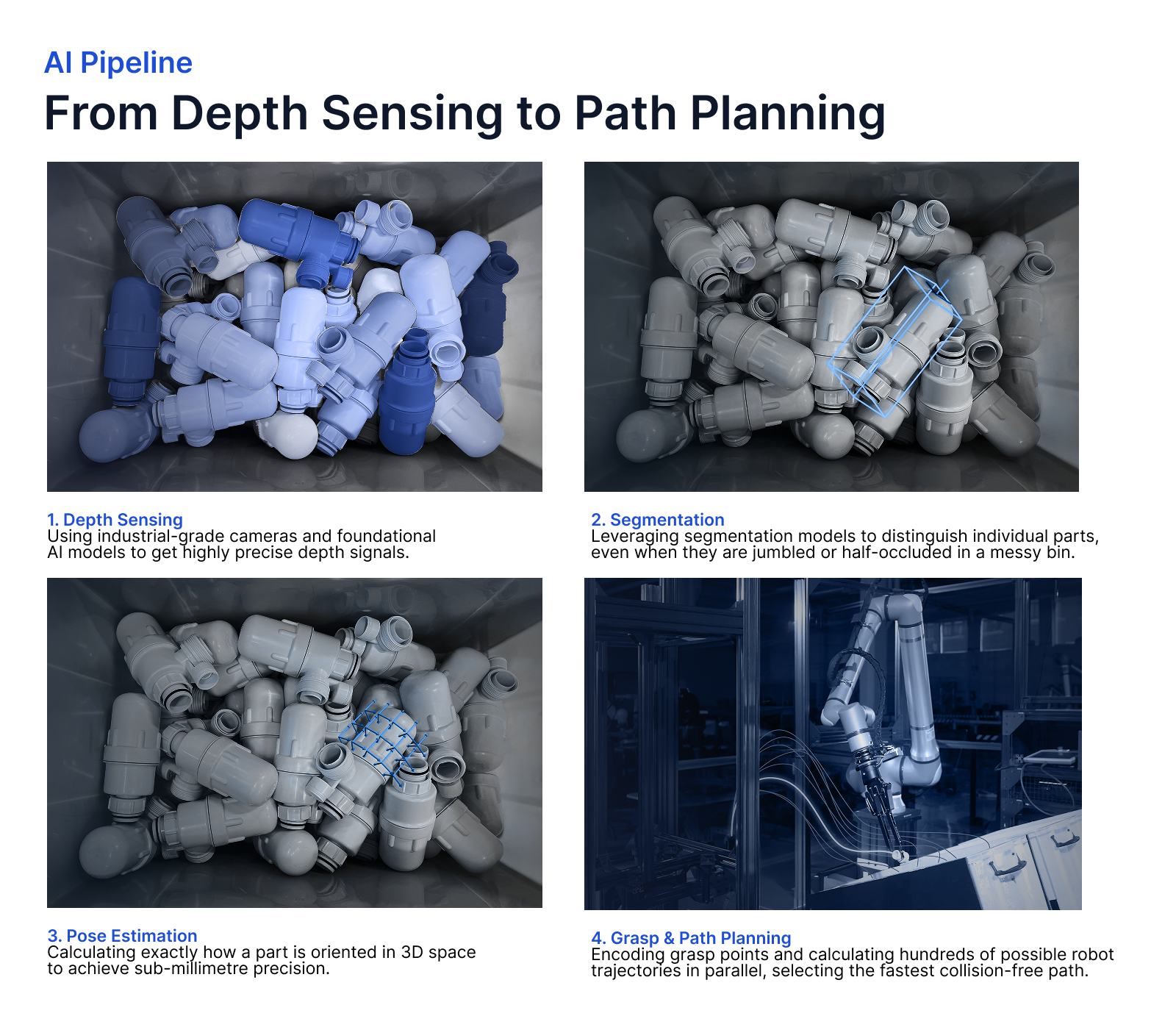
A 2D image tells the system the part exists, but 3D vision and depth sensing measure how far every point in a scene is, thanks to an industrial-grade camera and foundational AI models. For picking applications, it means the quality of depth data usually matters more than image resolution.
8. What is Physical AI Segmentation?
Physical AI segmentation separates a scene into individual objects. In a full bin, segmentation is what determines one part from another. When parts touch, overlap, or are partially hidden, modern segmentation models can isolate them, even if they don’t necessarily recognize them.
9. What is Pose Estimation?
Pose estimation determines a part’s exact position and orientation in 3D space. This includes where it is, how it’s rotated, and if and how it’s partially blocked by something.
This is a precision step that takes the notion “a part exists over there” and turns it into coordinates a robot can act on.
10. What is Grasp Planning?
Grasp planning means deciding where and how to grip a part. It includes which surfaces to contact, which angle to approach from, and which gripper orientation to use.
A good system generates hundreds of possible trajectories and ranks them by success probability. It takes into account the part’s pose, its neighbors, and the bin walls. Picking the right part the wrong way often fails, which is why this precautionary step exists.
11. What is Collision-Free Path Planning?
The aptly named collision-free path planning involves calculating a trajectory for the robot arm, the gripper, and the in-hand workpiece that avoids bin walls or other obstacles in the way. The system evaluates many possible paths and selects one that is both fast and safe.
For Vention users, the collision-free path planning technology is so precise and accurate that deep bin picking is achievable. It allows a gripper to work within millimeters of the bin walls to reach the bottom layer of parts.
12. What Does Edge Compute Mean for Physical AI?
Rather than using the cloud, edge compute refers to running the AI on a computer located at the machine on the factory floor. This way, decisions can be executed in milliseconds, production can keep running if the internet goes out, and data remains on site.
For live robot control, edge compute is a requirement, not an option or preference.
Evaluating a Physical AI Solution
13. What is a Pick Success Rate?
A pick success rate is simply the number of pick attempts that succeed. Stakeholders need to understand this number carefully. First-attempt success is different from eventual success after many retries. Both also depend on the parts, the lighting, and how full the bin is.
When a vendor quotes a particular pick success rate, always ask what is measured, which parts, and under what conditions.
14. What is CAD-Based Part Onboarding?
CAD-based part onboarding means introducing a new part to the system by providing its CAD file. The system then uses the part’s geometry to generate candidate grasps, rather than relying on physical trial-and-error or manual programming. This is what makes switching between parts a simple data exercise and not an entire engineering project.
The Physical AI Technical Terms
15. What is a Point Cloud?
A point cloud refers to the raw output of depth sensing. The output is represented by thousands or even millions of points, each with a 3D position. Together, they form a machine’s spatial map of the scene.
Every downstream step, from pose estimation to segmentation, works from the point cloud map. When you view a robotics demo showing a bin rendered as many colored dots, you are looking at a point cloud.
16. What is Occlusion?
When one part blocks the camera’s view of another, that’s occlusion. In a full bin, most parts are partially hidden by their neighbors, and occlusion is a classic failure of older vision systems. Historically, robots needed a clear, complete view of a part to recognize it. Modern segmentation and pose models, however, are built with partial views and potential occlusion in mind.
17. What is Hand-Eye Calibration?
Hand-eye calibration is the process of aligning a camera’s coordinate system with a robot’s. This ensures that a position seen in the image translates exactly to a position the robot can move to. If the calibration is off by even two millimeters, every pick is also then off by two millimeters. Hand-eye calibration is one of the unsung fundamentals that determine whether or not a vision-guided system performs in production.
18. What is Stereo vs. Structured-Light 3D Vision?
Stereo vision and structured-light 3D vision are the two main ways industrial systems measure depth. Stereo systems compare views from two cameras much like the way human eyes judge distance. Structured-light systems project a known light pattern onto the scene and then read how it deforms.
Structured-light has been historically known to deliver higher accuracy, while recent AI-based stereo methods have closed that gap by using simpler camera hardware. Both approaches are used in production across the industry.
19. What is Synthetic Data?
Synthetic data is training data that’s generated instead of collected. Rather than photographing a part hundreds of times on the floor, for example, it’s rendered in simulation, accounting for different angles, lighting, and positions in the bin.
Nobody has to stage and label a photoshoot for every SKU. The model learns from detailed renders, enabling a new part to go live in hours instead of weeks.
20. What is Sim-to-Real?
Sim-to-real is the gap between what works in simulation and what works on the floor. Simulation is never a perfect copy of reality. Surfaces reflect differently, lighting shifts throughout the day, and parts can show up scuffed or oily. A model that scores well on rendered images can still miss when it’s time to deploy.
Robot behavior can also be trained through simulation. Thousands of training attempts can take place overnight, instead of taking weeks on real hardware.
21. What Does In-Hand Localization Mean?
In-hand localization refers to re-checking a part’s exact position after it has been gripped, and then adjusting the placement trajectory to match. Grasps in a cluttered bin are rarely perfect, and a single part can sit slightly rotated or shifted in the gripper.
In-hand localization is what allows the system to place precisely anyway. This turns an imperfect pick into an accurate placement.
The terms in this glossary will keep shifting as robots take on more autonomy and manufacturers scale. As Physical AI matures from pilot projects to production lines, a shared language becomes the foundation for every decision that follows.
Stay current with the latest Physical AI terms with Vention, and learn more about Physical AI deployments through Vention’s Physical AI whitepaper.