Scaling automation remains one of the industry’s most persistent challenges. In the 2025 State of the Market survey by IndustryWeek and Vention, only 37 percent of manufacturers report having scaled automation successfully. The underlying issue is the need to reprogram robots repeatedly as conditions change, limiting their ability to scale across applications and facilities.
Recent advances in deploying Physical AI change this equation. Generalized intelligence now allows robots to perceive their environment and adapt actions in real time without retraining world foundation models or reprogramming cells for each new scenario. Unstructured tasks once considered impractical to automate, such as bin picking in high-mix environments, are becoming viable. A new class of production-ready AI is here.
Meet GRIIP™: The Physical AI Pipeline
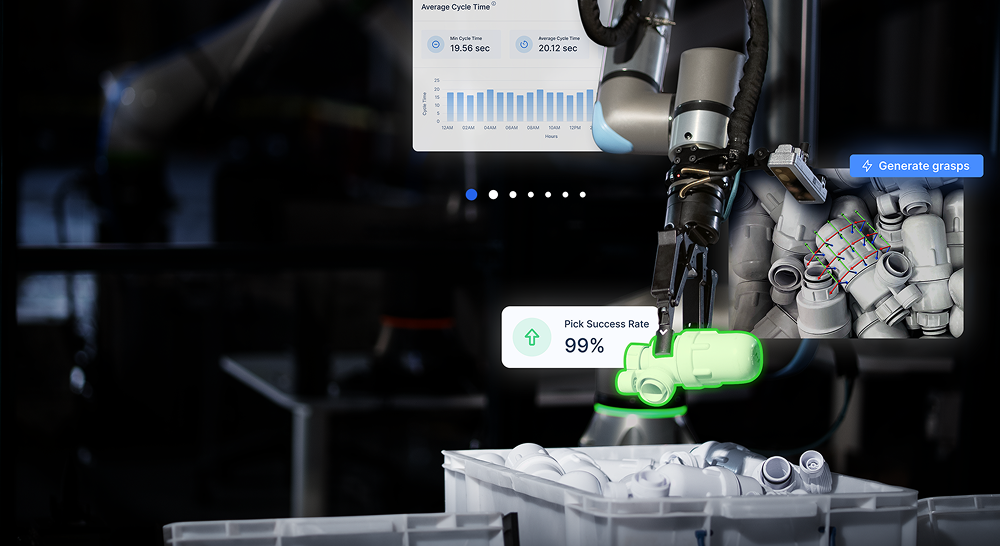
GRIIP is a generalized Physical AI pipeline that enables robots to operate autonomously in real-world manufacturing environments. Rather than requiring each task to be reprogrammed from scratch, GRIIP provides a reusable foundation that can be deployed across applications and scaled across locations.
By abstracting perception, grasp intelligence, pose estimation, and motion planning into a production-ready pipeline, it helps robot cells adapt to real world conditions without manual configuration, reducing deployment effort and the need for specialized expertise. Running on Vention’s MachineMotion AI controller leveraging the NVIDIA Jetson module-on-compute platform, GRIIP can convert existing traditionally programmed robotic applications into autonomous operations.
Under the Hood: How GRIIP Physical AI for Manufacturing Works
GRIIP leverages state-of-the-art foundation models from industry leaders such as NVIDIA, alongside Vention’s proprietary models in an integrated pipeline from perception to motion. This unique physical AI pipeline allows robots to operate reliably in unstructured manufacturing environments across a wide range of common tasks. Here are steps involved in creating a unified pipeline from perception to motion, designed to evolve continuously.
Meet Rapid Operator AI, powered by GRIIP.
Scene Digitization & Calibration
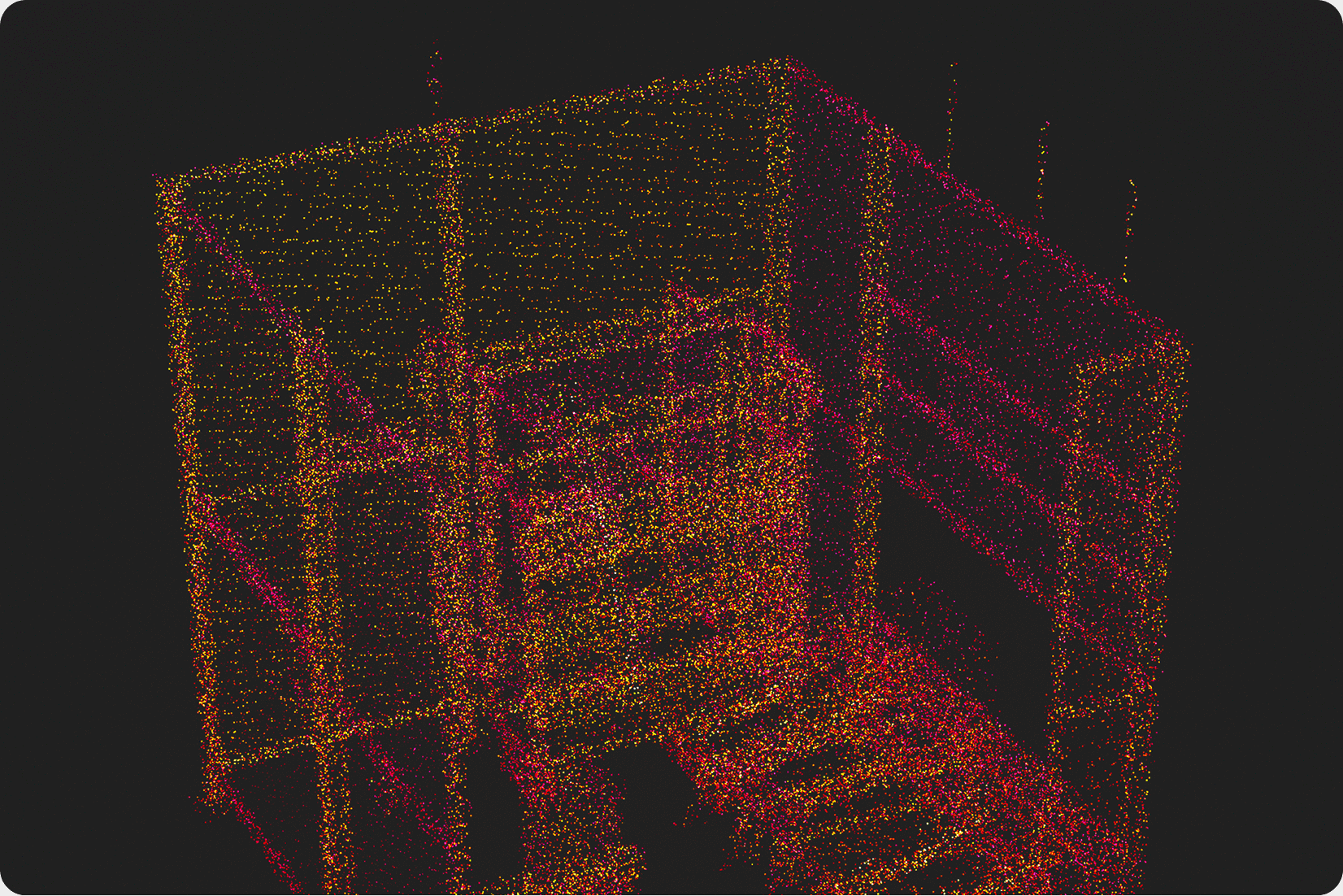
Calibration is a foundational capability within GRIIP. It helps build and maintain the digital representation of the robot’s environment for accurate spatial reasoning. GRIIP ensures 24/7 operations through reliable scene contextualization across changing conditions including low, uneven or no light.
GRIIP supports:
- Hand-eye calibration to align camera and robot coordinate systems
- Intrinsic camera calibration for accurate image interpretation
- Stereo calibration for depth estimation
- TCP calibration to ensure precise tool positioning
- Scene calibration to establish a 3D model of the environment
Perception and Segmentation
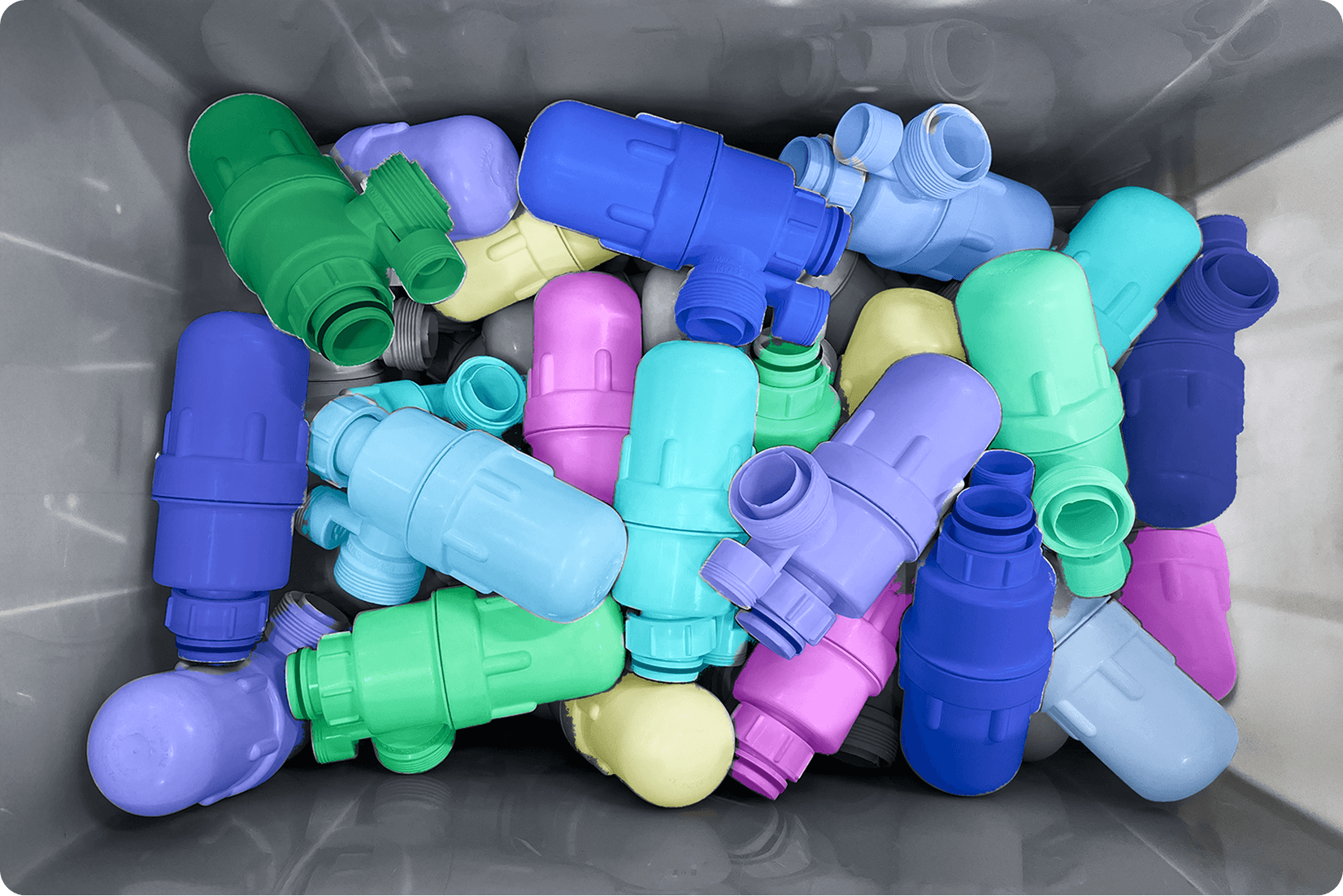
Real-time perception is one of the biggest problems in robot vision today, as a wide range of tasks cannot be completed without minimizing segmentation errors.
GRIIP enables robots to detect and segment objects based on image capture, even in cluttered environments. Objects are ranked to prioritize viable picks, allowing the system to reason about what can be handled at any given moment.
Pose Estimation
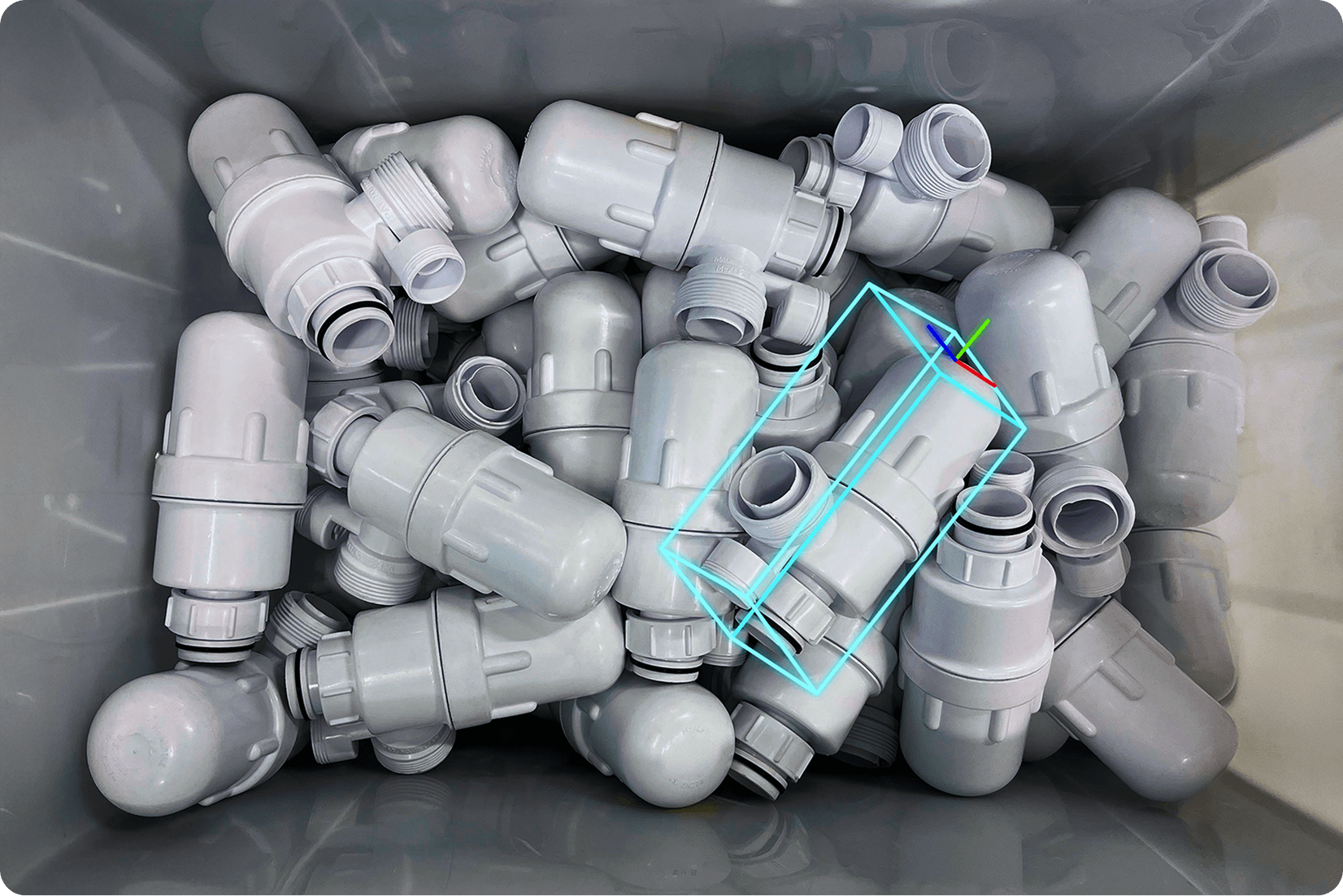
GRIIP powers pose estimation robotics to estimate object orientation and position with sub-millimeter accuracy throughout the manipulation lifecycle, from pre-grasp to in-hand. It provides 6DOF pose estimation for grasp point calculation and tracks object pose during manipulation for stable handling. It also adapts in real-time to object movements and shifts.
Grasping and Manipulation
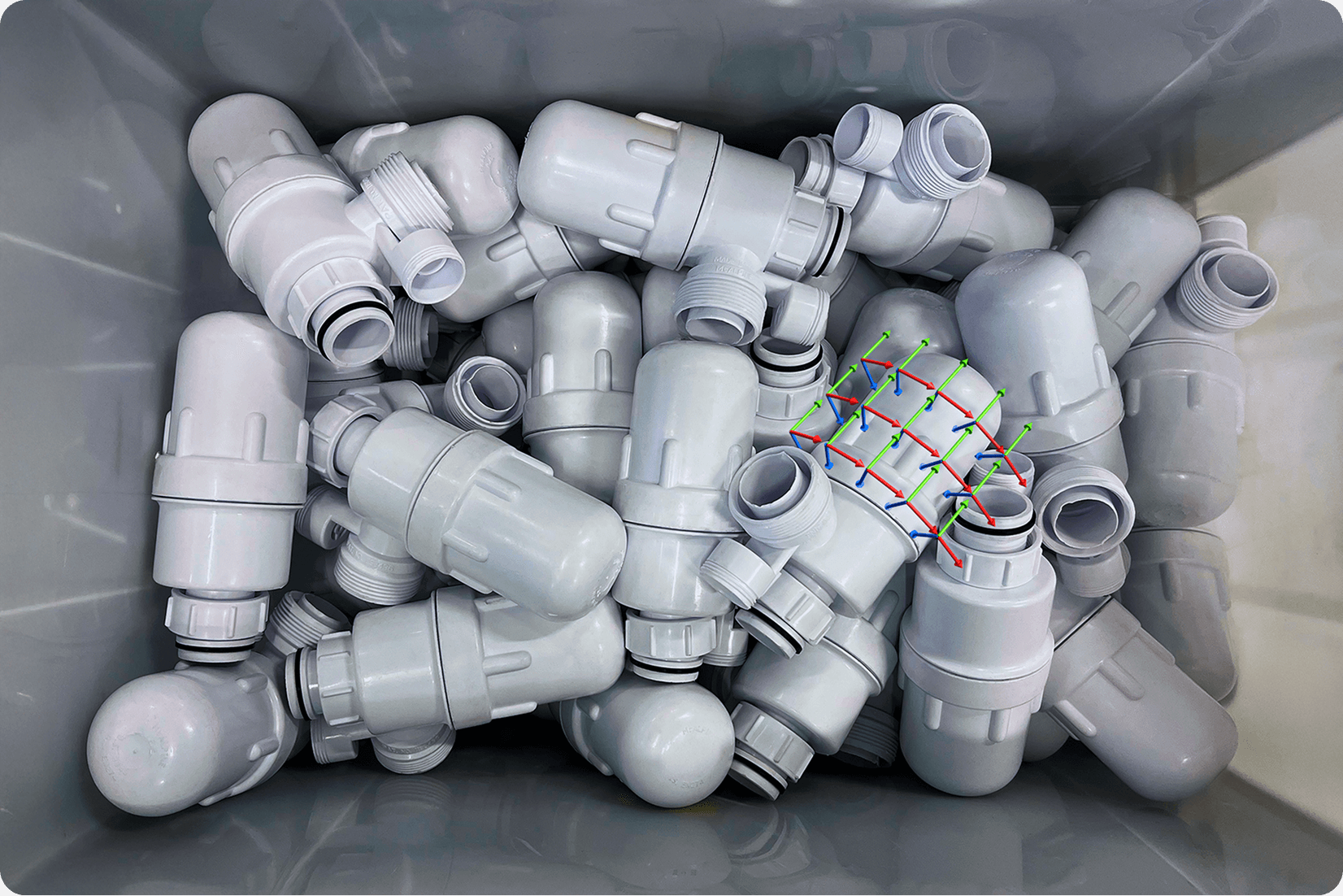
GRIIP’s robot grasp planning AI identifies and evaluates hundreds of pick candidates in real time, selecting the most reliable option based on the current scene and object state. Rather than relying on a single predefined grasp, the system maintains multiple viable options per cycle, allowing it to adapt to variation in part orientation, surface properties, and presentation.
This approach enables the system to extend beyond rigid motion logic while remaining practical for production environments.
Collision-Free Path Planning
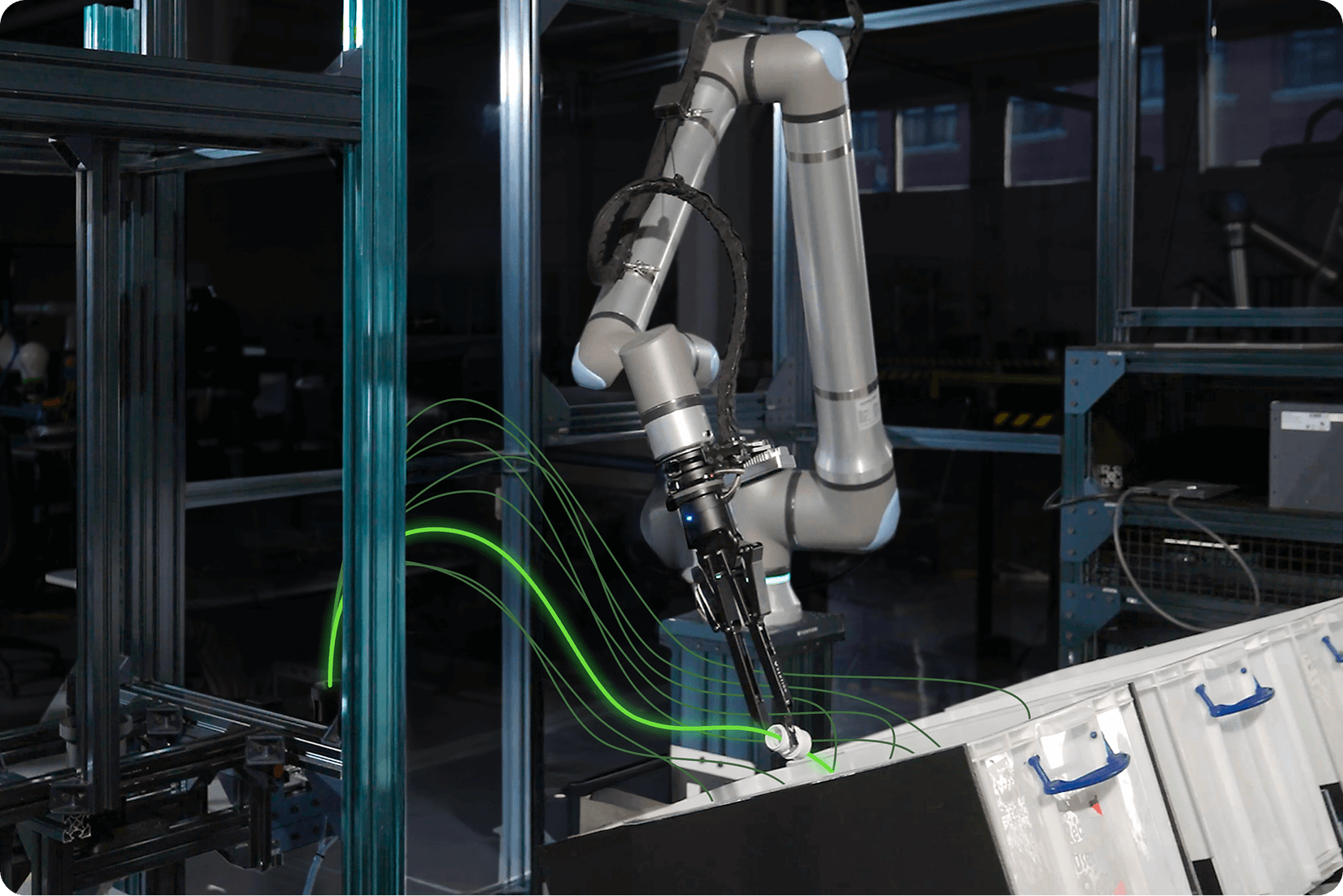
Collision-free path planning involves calculating robot motion with a continuous understanding of the 3D scene. Paths are filtered through inverse kinematics feasibility to ensure they can be executed by the robot, and collision-free trajectories are generated based on real-time scene awareness.
This combination allows robots to move safely and predictably within dynamic environments, even as parts, fixtures, or surrounding conditions change during operation.
Benefits of a Generalized Intelligence Layer
Engineered for real-world manufacturing conditions, GRIIP delivers adaptability without any tradeoffs. It handles production variability while maintaining the speed, reliability, and consistency required on the factory floor.
-
Generalizes across variability: Operates reliably across changing SKUs, part geometries, surface conditions, and lighting without custom logic for each scenario.
-
Expands the scope of automation: Unlocks new automation opportunities by extending the scope of automation to unstructured tasks previously considered unviable.
-
Scales across applications and cells: Replaces the one-robot-one-task model with a shared AI pipeline that supports multiple applications and standardized deployment.
-
Delivers production-ready performance: Designed for continuous operation with consistent pick success rates and predictable cycle times.
-
Enables faster changeovers with CAD to pick workflow: Users can simply upload the CAD file to onboard a new part in a few minutes, without the need to train and validate.
One AI Pipeline for Multiple Applications, Powered by GRIIP
Traditional robotics requires custom engineering for every task. GRIIP applies a single AI foundation across multiple manufacturing workflows, enabling one system to support many applications without task-specific programming.
- Deep bin picking: Reliably picks randomly oriented parts from deep bins. Handles mixed SKUs, variable geometries, and cluttered scenes without task-specific programming.
- Machine tending: Loads and unloads parts for CNC machines, presses, and other equipment. Adapts to part variation and orientation changes while maintaining stable cycle times.
- Conveyor pick and place: Tracks and picks moving parts directly from conveyors. Adapts to variable positioning and changing speeds without recalibration.
- Depalletizing: Unloads parts from pallets with varying stack patterns and orientations. Handles mixed loads and adjusts to different pallet configurations automatically.
- Kitting: Builds kits by picking and placing multiple part types into trays. Automatically adapts to different components, quantities, and configurations.
- Sanding with AI vision: Executes precise surface finishing on complex geometries. Adapts tool paths to actual part pose and surface variation to ensure consistent quality.
All of these are powered by the same generalized intelligence pipeline, allowing manufacturers to reuse capabilities across workflows.
Part of AI-Defined Automation: The Newest Era of Manufacturing Automation
AI-Defined Automation refers to building, deploying, and monitoring manufacturing automation. Each layer of the workflow is rich with artificial intelligence, and automation is enabled for historically manual-only tasks. AI-Defined Automation combines Agentic and Physical AI.
On the agentic side, automation creates itself by having users design cells and ship production-ready code by simply asking with plain-language prompts. On the Physical AI side, thanks to technology like GRIIP, robots use sophisticated models to sense what’s in front of them, decide how to reach it, and then act on it. Because they can perceive and adapt to real-world variability, they can retry and recalculate actions and operate more autonomously than ever.
The goal of AI-Defined Automation is to shorten deployment times, make automation accessible to non-technical teams, and repurpose engineering and operating resources. It’s the most efficient era of automation yet, and GRIIP is a key contributor.
A Foundation for Autonomous Manufacturing
As manufacturing environments become more variable and automation demands grow more complex, intelligence must become reusable, scalable, and production-ready. GRIIP represents a shift from rigid automation logic to generalized Physical AI models that can evolve with the factory, turning robots into autonomous systems rather than scripted machines.
Interested in evaluating GRIIP for your application?
Connect with our manufacturing AI experts to explore how GRIIP can automate your unstructured tasks.


