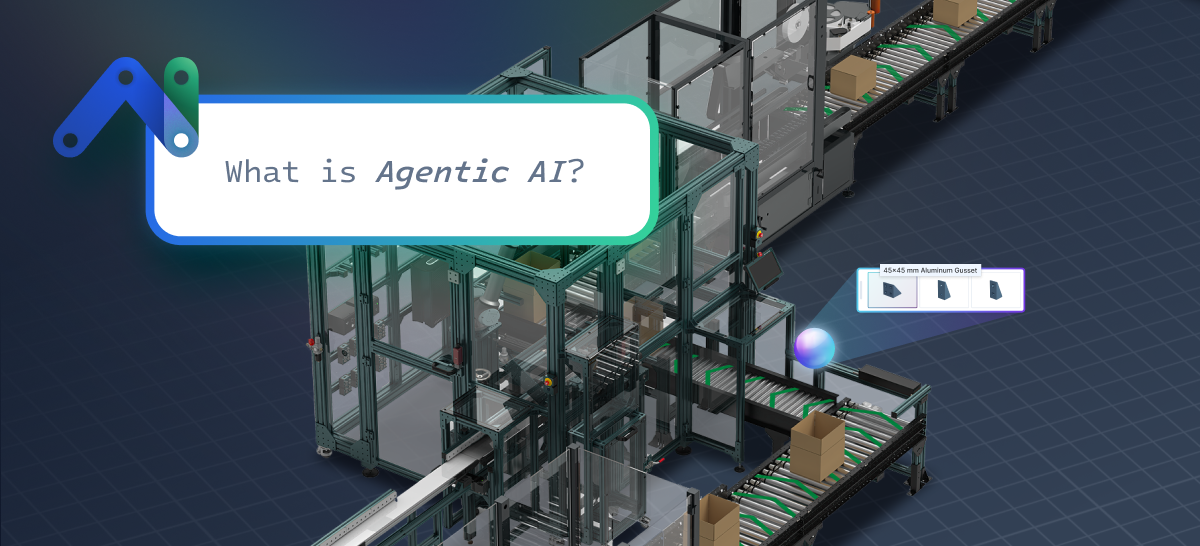
Agentic AI has emerged in many industries as a means of updating CRMs, handling customer interactions, and processing IT requests autonomously. But in the industrial automation space, it’s proving to be much more hands-on, contributing to the design, programming, and operation of an automated cell.
Here is what Agentic AI means, how it works on factory floors, what makes it autonomous and accessible, and what to consider before implementing.
What is Agentic AI?
Agentic AI is an artificial intelligence system that can independently make decisions and take action in multi-step sequences to achieve a goal without human intervention. Whereas solely using generative AI means waiting for prompts and directions before executing, Agentic AI is proactive, breaking objectives down into steps, using external tools and APIs, and adjusting work based on new data without being prompted.
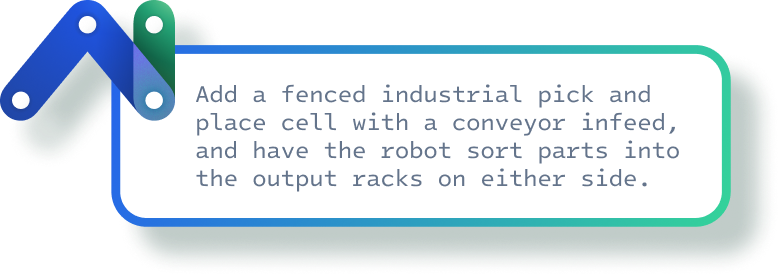
In a manufacturing automation context, Agentic AI understands natural language directions, generates cell layouts, writes production-ready code, and diagnoses operational issues across production lines. This means non-technical teams can design, program, and operate automation without relying on engineers to take on all of that work. With less time spent on these tasks, engineering resources can be reallocated to higher-value initiatives.
Agentic AI Terms to Understand
Outside of Agentic AI itself, it will be useful to understand the following terms before evaluating agentic solutions.
-
MCP: A Model Context Protocol allows AI applications to communicate with external tools, databases, and software with a single universal interface. Some think of it as a “USB-C port for artificial intelligence”.
In industrial automation, shop-floor data is typically locked inside fragmented digital systems and software. Agentic AI in these cases can serve as an MCP, using its “brain” to process these siloed systems and surface answers to requests like “Why is my average uptime lower this week than last week?”
-
IDE: An Integrated Development Environment is a software application used to program, configure, test, and maintain control hardware like PLCs (Programmable Logic Controllers) or MachineMotion AI.
An AI Agent on an IDE, like Claude Code, helps engineers write, test, and deploy code or logic for these controllers, as well as for human-machine interfaces (HMIs) and factory edge systems.
-
CLI: A Command-Line Interface functions as a text-based bridge, where AI agents can interact with a robot, controller, or software system by typing commands, rather than using graphical interface options like dashboards, buttons, or drag-and-drop programming.
-
SDK: A Software Development Kit is a collection or “kit” of programming tools, code libraries, and APIs that engineers use to build, test, and deploy automation systems on the factory floor. Some SDKs are built specifically with certain software in mind, like the Vention Developer Toolkit. This helps developers interact with the software in a more tailored way.
-
Skills: Skills are packaged sets of instructions, workflows, or resources that teach an AI agent how to perform a task. They activate automatically when an applicable prompt is entered, so the user doesn’t have to re-explain rules or parameters each time.
It’s worth noting that skills are guides. AI agents can produce incorrect or incomplete outputs, and these should be reviewed by the right technical teams prior to deployment.
What Came Before Agentic AI in Industrial Automation?
The earliest days of industrial automation were hardware-defined. Tools and programming were segmented, and hardware design, controller programming, deployment, and commissioning were long, unstructured processes. Engineering resources were also deeply strained.
Then came the Software-Defined Automation era. Most automation projects live within this era today, where individual browser-based tools are used for design, programming, and monitoring. For those with end-to-end software tools, teams can unify these processes within one vendor and thereby speed up the project lifecycle.
Agentic AI comes to us in the most recent era: AI-Defined Automation. Here, artificial intelligence is embedded into each layer of the industrial automation workflow and collects data, performs troubleshooting, and monitors systems without being prompted. The AI-Defined method automates historically manual parts of the workflow. Here’s where Agentic AI contributes.
Agentic AI: What it Looks Like in Practice
Conventional automation has largely used industrial computers and ladder logic for decades. This is the programming language used on PLCs and is built for fixed, repetitive sequences. It excels at telling machines to do the same thing the same way, repeatedly. It isn’t built to talk to or advance from AI models.
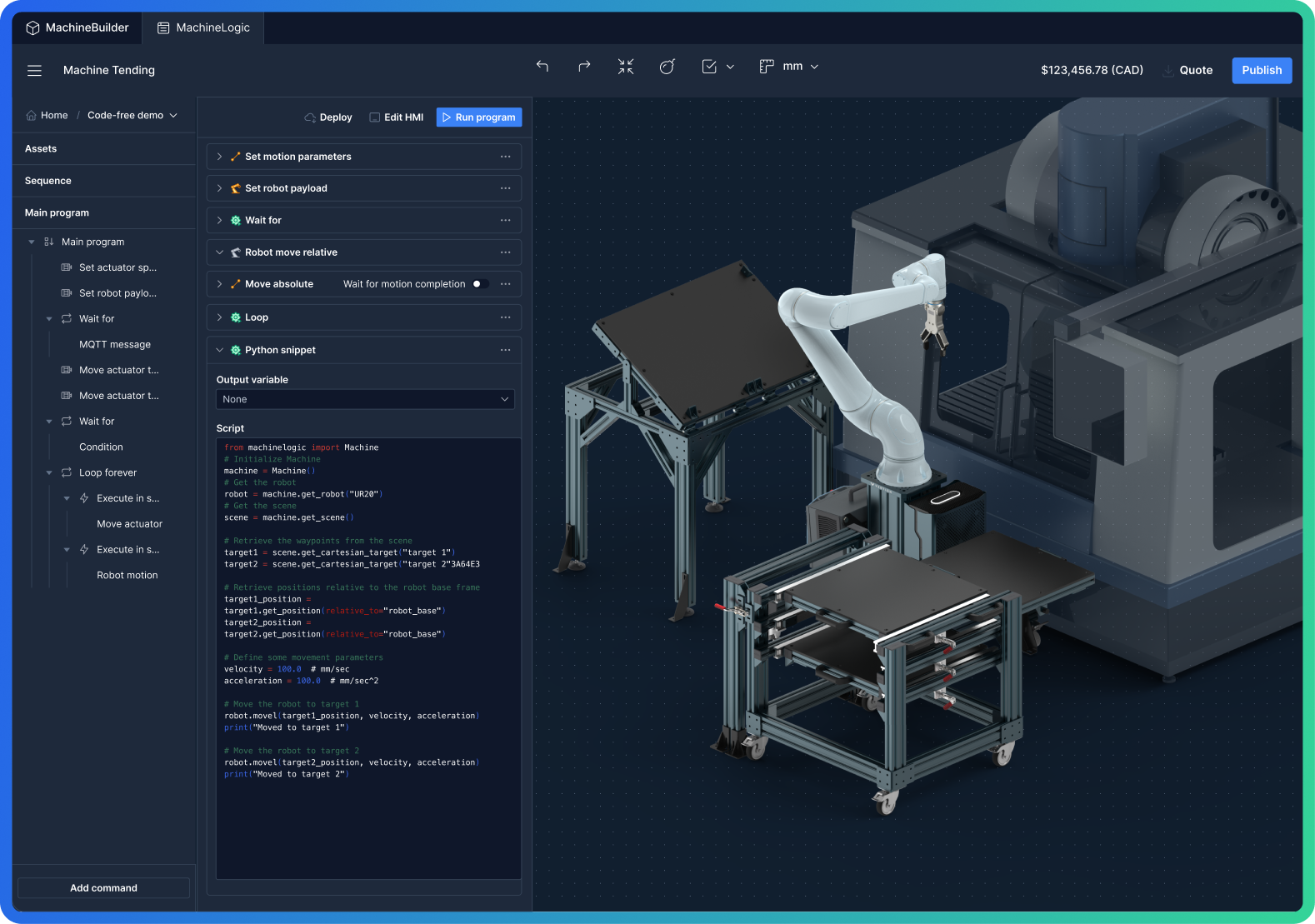
Agentic AI can show up in many elements of today’s automation workflows, but particularly in the software-defined programming language Python. It’s the language of modern software and AI-based automation development, making it the natural choice for end-to-end automation solutions. Here’s how Agentic AI works in each workflow stage:
-
Design: Users can describe an automated cell in plain language and have Agentic AI design the floor plan based on their vision.
-
Programming: Agentic AI can also ship production-ready code, reducing the need for engineering to bring the design vision to life on their own.
-
Analytics: Agentic AI surfaces analytics pertaining to a single cell or covering entire production lines across multiple floors. There’s no need for complex dashboard analyses to check every inquiry.
-
Troubleshooting: Agentic AI can identify issues based on sensor or cable data, surface machine logs, or diagnose faults. Once identified, the agent will also recommend ways to resolve the problem so the user can take action.
By letting Agentic AI drive each stage of the workflow, time to deploy will decrease. Engineering and integration resources can also be redistributed, and there’s less risk of human error in each step.
Why the Agentic Approach is Emerging Now
The Manufacturing Institute and National Association of Manufacturers estimate that 2.1 million manufacturing jobs could be vacant by 2030, driving an economic impact of $1 trillion for that year alone. Separate research from CADDi finds that 79% of manufacturing leaders cite the skill gap as their top challenge.
The workers who remain are stretched thin and have limited time to become experts in ladder logic programming. And with looming pressure to deploy faster, manufacturers are leaning towards tools that require less specialized technical expertise.
That’s where Agentic AI lowers the bar. Instead of requiring controls engineers to hand-code robot behavior, Agentic AI actions various parts of the automation lifecycle, from initial design to production line monitoring. Of course, the need for engineers and other technical experts remains, but the agentic approach changes what their labor is spent on.
Things to Consider Before Implementation
Agentic AI is a force multiplier for teams deploying automation, but it doesn’t mean the workers in charge of building and operating automation get to walk away completely. Manufacturers implementing Agentic AI should consider:
-
Is the design layout based on real hardware, part of a broader end-to-end ecosystem, and using pre-validated designs?
-
Is the design laid out well enough, or do you need to do further customization yourself?
-
Does the program need different or additional steps (and prompts to complete them) to be entirely built based on the complexity of the cell?
-
Does the program need more fine-tuning based on the complexity of the cell?
-
Does the software suggest actions to take when troubleshooting on both hardware and software issues?
Internally, during phases like designing and programming, it’s particularly important to determine where the handoff between agentic reasoning and human judgement lies.
Agentic AI: An Automation Partner for Growth
AI in industrial automation has moved from a documentation or bolt-on analytics tool to a hands-on role in design, programming, and troubleshooting. For organizations willing to invest in an AI-defined approach, it means faster time to ROI and a leg up in the market.
Learn about the newest era of industrial automation with Vention’s AI-Defined Automation guide.