When we think about modern automation with software and robotics, we think about the engineering teams required for implementation. Dedicated technical expertise, for many manufacturers, simply isn’t feasible. And with that, automation is quickly written off.
But in a new era of AI and automation, accessibility is greater than ever. If your business has the buy-in to automate the factory floor, but lacks the engineering resources for evaluation and deployment, here’s what you need to know.
Conventional Automation: Where Engineering Expertise is a Must
For many manufacturers, automation adoption is limited because much of the automation market is fractured and difficult to navigate at best. Teams without technical knowledge struggle to identify the right solutions for their use case, and as many as 39% report lacking the internal expertise to move forward with a solution, according to the 2025 State of the Market Report from Vention and Industry Week.
Teams who manage to move forward with implementation often opt for fragmented, multi-vendor systems that fail to integrate smoothly. This creates bottlenecks at multiple stages of deployment, from design to operation. The best-case scenarios with conventional automation often lack a clear path to reliable execution. It also means:
- Existing automation configurations are difficult to maintain without niche technical expertise. PLC language is unique to industrial automation, and qualified specialists are fewer in today’s workforce.
- Small changes could require external specialists, slowing down improvements.
- Minimal support and training prevent teams and lines from becoming autonomous.
Conventional automation is largely either inaccessible or inefficient. Most businesses are left with high-risk projects, inconsistent results, and ROI that remains uncertain.
Breaking Accessibility Barriers With Modern Automation Software
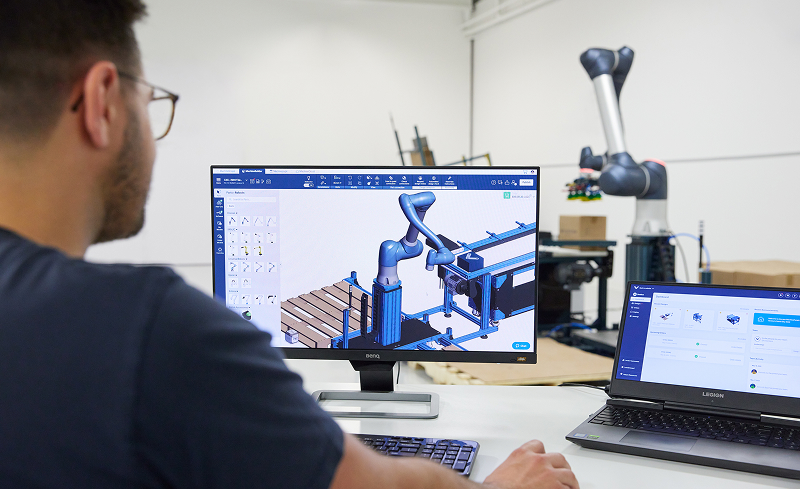
With more manufacturers considering automation, modern providers are offering low-code or no-code solutions, better support, and platforms that use plain language. Offerings vary from platform to platform, but a reputable automation solution would support:
- AI guidance and no-code programming: These capabilities enable non-experts to build and adjust automation without deep technical knowledge.
- Design and programming smart assistance: Complex steps of the automation workflow are made easier with embedded assistance, ultimately reducing errors.
- Workflow support: Whether a user needs help with design, programming, deployment, or troubleshooting, design and program services, deployment assistance, live remote support, and training, help with automation ramp-up.
- Remote maintenance: Routine maintenance support keeps operations stable and gives teams insights into operational details.
Vention’s MachineBuilder, MachineLogic, and support and service resources meet this criteria on a unified end-to-end platform.
Where Agentic AI Deepens Accessibility
.png)
Agentic AI brings artificial intelligence to the automation of the cell, thereby deepening accessibility further. Users can ask an agent plain-language questions, much like they would with a popular LLM tool, and have the AI drive each industrial automation workflow stage.
This enables digital automation for historically manual tasks, effectively automating industrial automation. Here’s what that accessibility looks like on a stage-to-stage basis.
Design
With Agentic AI, teams can describe an automation cell in plain language and watch the AI shape it via a floorplan. With Vention, the Agentic AI can select optimal pre-designed cells and apply them directly to an open design without the CAD experience. By prompting with an agent instead of manually designing, users get a pre-validated design or a simple layout and effectively reduce this process from days to minutes.
Programming
At the programming stage, users can generate production-ready code with Agentic AI by simply describing their desired motion logic to the agent. There’s no local setup required.
For teams that prefer to work locally or need greater programming precision, they can run the AI agent on a local IDE with an MCP and skill that allows them to connect to the programming software tool. Once provided with the right project context, the generated code will be highly detailed and ready to ship.
Operating
Once deployed, Agentic AI can be used in the operating stage for analytics and troubleshooting. Users can ask agents data-related questions as simple as “What is the average downtime across sites this month?” and the agentic output comes well-formatted and easily digestible.
The agent can also identify cable or sensor issues, surface machine logs, and diagnose faults to simplify troubleshooting. Once a problem is identified, the agent will recommend a way to action it to go live once again.
Part of AI-Defined Automation: The Newest Era of Manufacturing Automation
AI-Defined Automation is a means of building, deploying, and monitoring automation on factory floors. Each part of the industrial automation workflow is powered by artificial intelligence, which opens up automation for tasks that were previously manual only.
An AI-defined approach is an accessible one, meaning engineering expertise can be repurposed, the labor gap can be reduced, and time to deployment is shortened. It’s the most efficient era of automation to date, and leverages both Agentic and Physical AI.
As mentioned, the Agentic AI element puts non-technical users in control with plain-language prompts powering the design, programming, and operating parts of automation. On the Physical AI side, robots and machines use sophisticated models to perceive, reason, act, and adjust to the real world through one pipeline. The machines learn and adapt to unpredictable tasks, retrying failed actions on their own. This autonomous functionality means there’s no need for engineers to step in each time a robotic action is unsuccessful.
The Ripple Effects of Accessibility
Outside of implementation, a significant consideration of whether or not to automate lies in the time-to-value. For many solutions, ROI is unclear, making the designing, programming, and deployment difficult to justify.
But raising automation accessibility also shortens the value payback period. With Physical AI modular pipelines, robot parts are onboarded via a CAD file and come preprogrammed almost out of the box. Without the need to conduct weeks of data collection, the Physical AI aspect of automation sees initial uptime in as little as a few minutes.
With modern automation software and Agentic AI, non-technical users are guided through each stage of the implementation process, shrinking many phases from weeks to hours. With greater accessibility comes faster deployment, scaling, and ultimately better time-to-value.
Heading Toward a More Autonomous Future
Industrial automation has moved from fixed hardware to software to AI-Defined Automation that drives itself. In turn, the internal debates about whether or not to automate transform into questions around how quickly the team can profit from their systems.
Looking to learn more about Agentic AI and AI-Defined Automation? Check out our starter guide.