Today, a significant factor impeding plans for a new automation project is time-to-value. Automation equipment and robotics are often positioned as a worthwhile investment, but rising cost pressures and tight timelines push buyers to become increasingly risk-averse. That time-to-value, or time-to-ROI, needs to be concrete before manufacturers even consider investing.
This article walks you through the newest era of automation, AI-Defined Automation, and how the right platforms speed up time-to-value through AI-driven design, programming, deployment, and operation. Here’s what buyers need to know to ensure an automation investment pays for itself as quickly as possible.
What is AI-Defined Automation?
AI-Defined Automation refers to using artificial intelligence to build, deploy, and monitor automation and robotics on factory floors. AI is uniquely embedded in each step of the deployment workflow, making functions that have historically been manual newly mobile. In essence, it automates the automation process.
The goal of AI-Defined Automation is to make deployment faster and more reliable than ever before. It’s also made to be more accessible to non-technical teams, enabling engineering and operations teams to redistribute their expertise and thereby help bridge the labor gap. Today, it’s the most efficient era of industrial automation.
The Cost of Slow Automation Deployment

A significant factor in driving costs is poor planning and execution. According to a Vention study, if a manufacturing team is opting for a fragmented tech stack, it means slower time to deployment, unreliable performance, and a greater chance the project goes over budget.
Unplanned expediting might seem like the answer, but that can also lead to disruptions like changeover delays for other SKUs and premium freight. Lastly, scrapping and reworking also eat into margins you’ve already earned, accounting for 2.2% of your annual revenue. Every defective part costs the business twice: Once when you make it wrong, and once when you fix it. Most manufacturers undercount both.
According to research from SP Automation & Robotics, the journey from automation concept to commissioning for bespoke systems is between 3 and 9 months. Conversely, A study from Stanford University cites that agentic AI, part of AI-Defined Automation, showed 71% median productivity gains, versus only 40% for “high automation” (AI that uses humans to review only exceptions and final outputs).
A good AI-Defined Automation platform is built on a good Software-Defined Automation platform, and is key for making every stage of the workflow, including scaling, faster. With agentic making great strides in productivity and deployment speed, businesses can more easily justify the initial investment.
The Two Layers of AI Driving Speed
Agentic AI
The agentic layer brings artificial intelligence to the automation project workflow. Users can:
- Design a cell in plain language
- Ask questions to diagnose issues
- Ask for performance and insight visibility across sites
- Ask AI to write production-ready code
By using Agentic AI to enter plain-language prompts much like a popular LLM tool, the workflow is both more intuitive and accessible, as teams require less direct engineering expertise.
It also means the whole workflow is faster. With one unified platform, there’s no handoff friction, and because designing, programming, and monitoring are done with AI, parts of the automation process that took weeks now take days.
Physical AI
The Physical AI layer uses artificial intelligence to power the robots on the factory floor. Physical AI pipelines like Vention’s Generalized Robotic Industrial Intelligence Pipeline (GRIIP) can:
- Sense object depth
- Segment parts
- Estimate grasp poses
- Plan a collision-free path to pick the object
Historically, if a pick failed, the action was abandoned. A human would then have to intervene, effectively slowing down the line. But GRIIP can adapt to unpredictable scenarios, learn from them, and retry the action.
Because the robots adapt and retry autonomously, engineers aren’t required to reset, readjust, or reprogram a machine every time an action is unsuccessful. With the proper Software-Defined Automation Platform, the robots are also onboarded via CAD file, and the hardware, vision, and AI are combined in one stack and ready to deploy. Once live, lines go uninterrupted, uptime is greater, and the ROI is better across the whole project.
Accelerating Each Automation Workflow Stage
The main draw to AI-Defined Automation is its ability to automate parts of the workflow that were previously manual or static. Here’s what that looks like at each stage of the workflow, and how it accelerates time-to-value.
Design
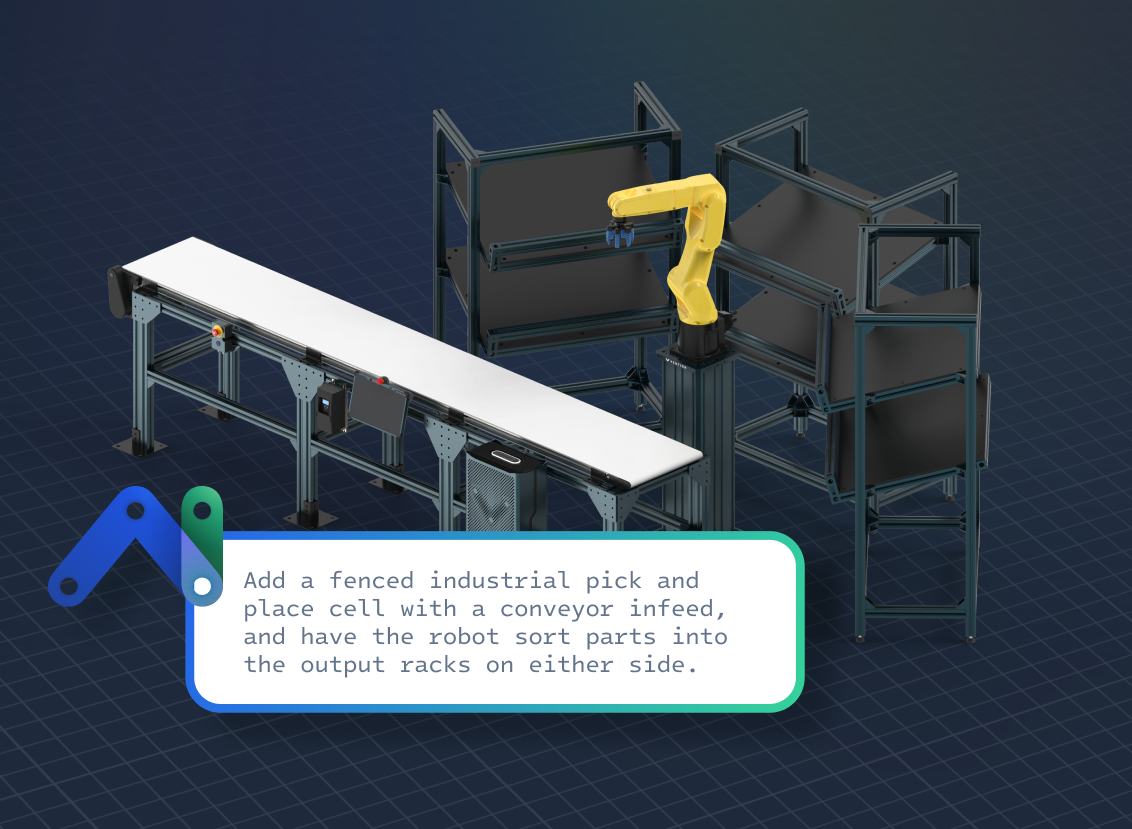
Users designing with AI-Defined Automation can describe a cell in plain language and watch it take shape. The AI will select pre-designed cells and apply them to an open design, no CAD experience required. In future iterations, Agentic AI will enable connecting selected cells together to further expedite the design process.
Program
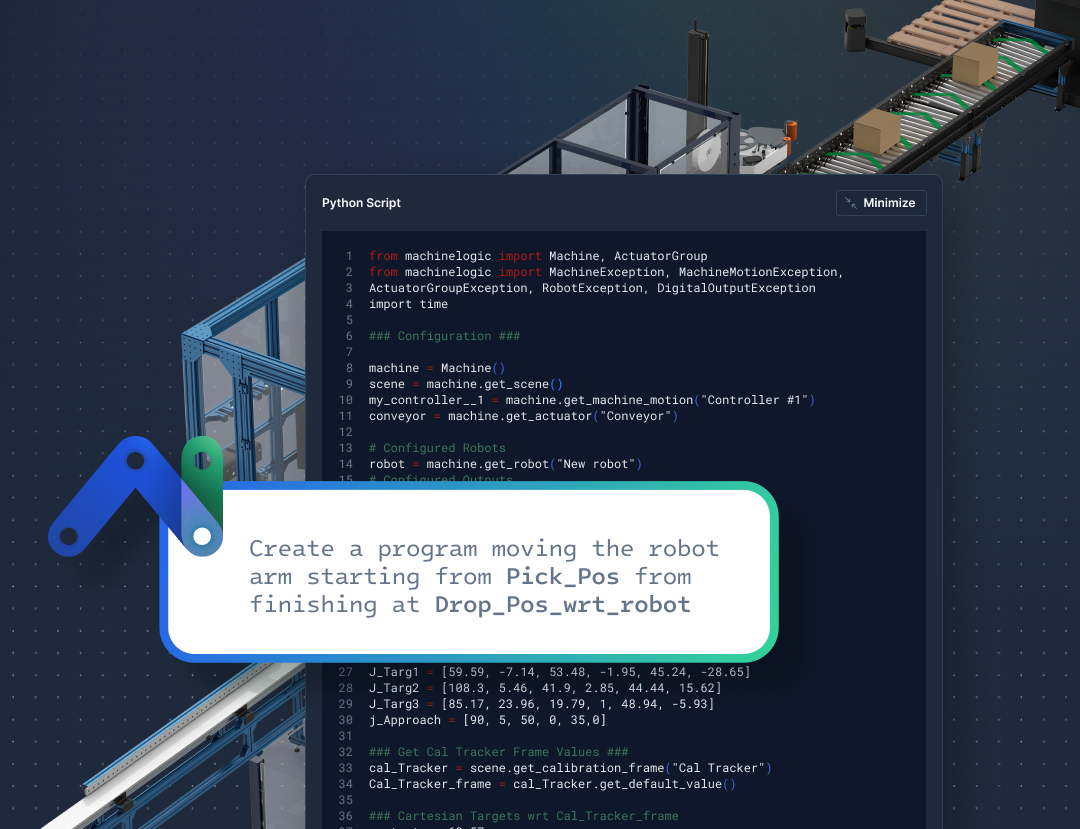
Much like in the design phase, users can enter plain-language prompts into Agentic AI tools to generate code in seconds, without the need for local setup. If a team prefers working locally, or needs to program with greater precision, the AI agent can be run in a local IDE. Once the project requirements are plugged in, the generated code will come highly detailed and ready for production.
Vention’s GRIIP also makes programming robots ready out of the box by onboarding parts via a CAD file. Once live, the robots can perceive and segment, estimate poses, correctly grasp, and plan a collision-free path while in picking. GRIIP is also one of the only solutions on the market that operates in a variety of factory environments, including those with inconsistent lighting.
Operate
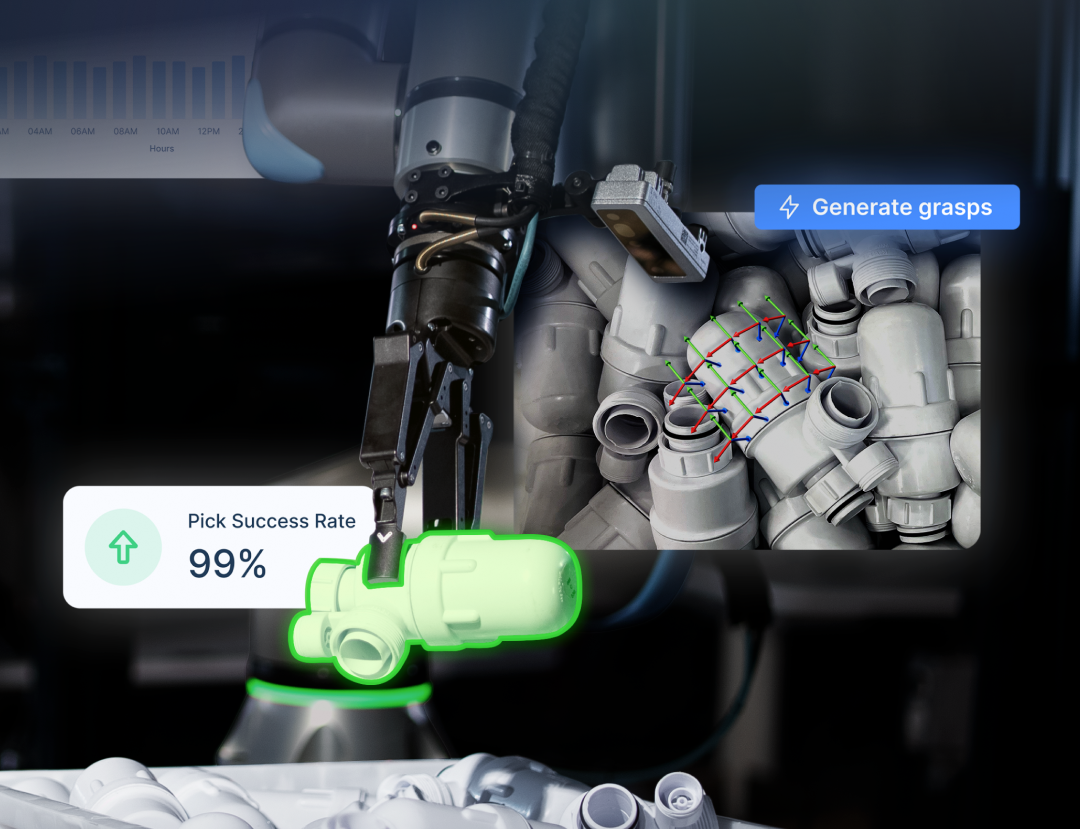
At the operating stage, Agentic AI can be used for troubleshooting and surfacing analytics. AI gathers machine logs, identifies sensor issues, and diagnoses errors or faults. For analytics, queries like “Which sites experienced the most downtime last month?” are actioned instantly, and the output provides the user with insights for whatever they’re after.
On the Physical AI side, the robots learn, act, and improve autonomously. They perform a variety of structured and unstructured tasks, including kitting, pick-and-place, deep bin picking, sanding, palletizing, and machine tending.
Scaling Automation Speed Across Sites
Because AI is baked into each layer of the workflow, total project costs are lower, payback periods are shorter, and automation is scaled without the scaling spend. Vention is the only end-to-end solution providing AI-Defined Automation for manufacturers today, and exceptional time-to-value is one of many benefits for businesses aiming to outpace the competition.
Looking to learn more about AI-Defined Automation? Get the guide here.