If you run a factory floor, you know how important end-of-line operations are. What a lot of manufacturers don’t know, however, is that you could be leaving money on the table if your palletizing operations are outdated, ill-fit, or manual.
More often, factory floors are automating palletizing. And it’s not just the big guys. Small to midsize factories are also reaping the benefits of investing in Physical AI-driven palletizing. In this article, we’ll define palletizer automation, when to use it, the different types of palletizers on the market today, and what to look for when it’s time to evaluate a solution.
What is Palletizer Automation?
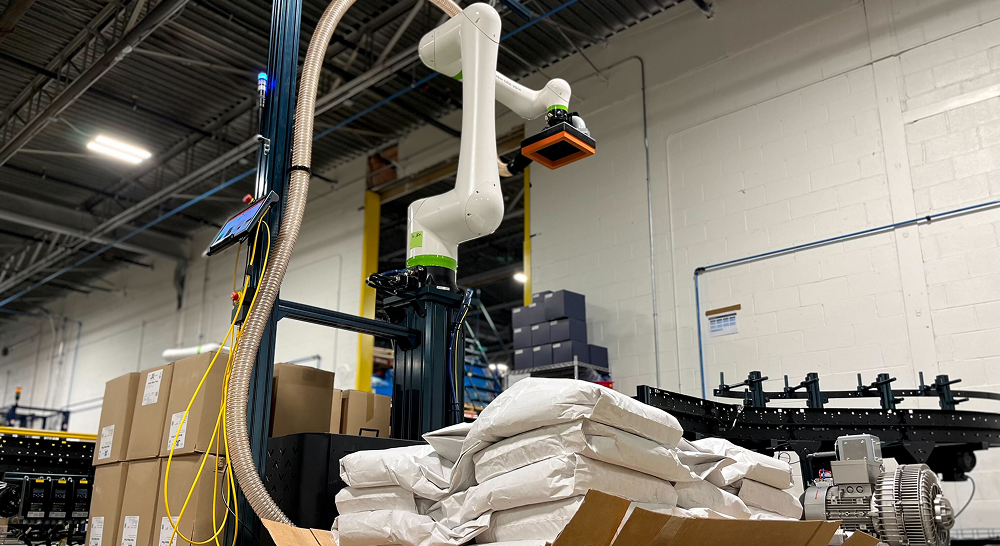
Palletizer automation refers to robotic systems that lift products and stack them onto a pallet autonomously. It replaces manual box, bag, and package stacking and is an integral part of every production line. Robot arms make repetitive movements, including picking the items off of a conveyor, arranging them in a stable pattern, and building the pallet one layer at a time.
The technology powering automation spans a range of capabilities and configurations. On one end, there are compact collaborative robots working alongside real workers, and on the other, large industrial robots are gated off, handling large payloads and throughput. But across these robots, the core functionality is the same. The physically demanding, injury-prone manual task is made into a consistent process that runs itself.
How Palletizing Robots Work
Palletizing robots follow a somewhat repeated sequence, guided by various forms of programming on the robot’s controller.
- Identify the object: Once packaged, products arrive on an infeed conveyor. Typically, single-SKU lines run on a fixed program, whereas multi-SKU lines use vision systems or barcode scanners to tell the robot what’s coming. This helps the robot adjust its pattern and know which pallet to stack products on.
- Pick it: The incoming box is always placed in the same spot, so robots can pick it and build the pallet according to the pattern it knows.
- Place it: The robot follows a stacking pattern, positioning each item precisely layer by layer. In some cases, slip sheets or corner boards are used for stability.
Then, the robot repeats until the pallet is complete. Sensors, light curtains, and sometimes physical guarding keep the areas safe for anyone working nearby, but full safety configurations may vary based on the scope of the work and robots used.
When to Use Manual Palletizing vs. Automatic Palletizing
If it isn’t broken, why fix it? Many manufacturers with manual palletizing processes fail to see the need to automate, with their tried-and-true systems firmly in place. But while manual palletizing does have a low barrier to entry, it comes with costs that compound over time.
The manual approach involves physically demanding work like repeated bending, twisting, and lifting that drives up injury rates. And it’s also increasingly difficult to staff. Manual palletizing roles see high turnover rates, and each departure means new hiring and onboarding. Then, teams must wait for new workers to ramp up to full performance.
Automated palletizing speaks to each of these pain points. Robots don’t get injured, don’t get sick, and don’t need to ramp up to full efficiency in the same way. On top of that, robots have become increasingly easy to use. Switching between SKUs is also made simple, and platforms like Vention offer unlimited recipes and easy-to-navigate interfaces.
Understanding Cobot Palletizers and Industrial Palletizers
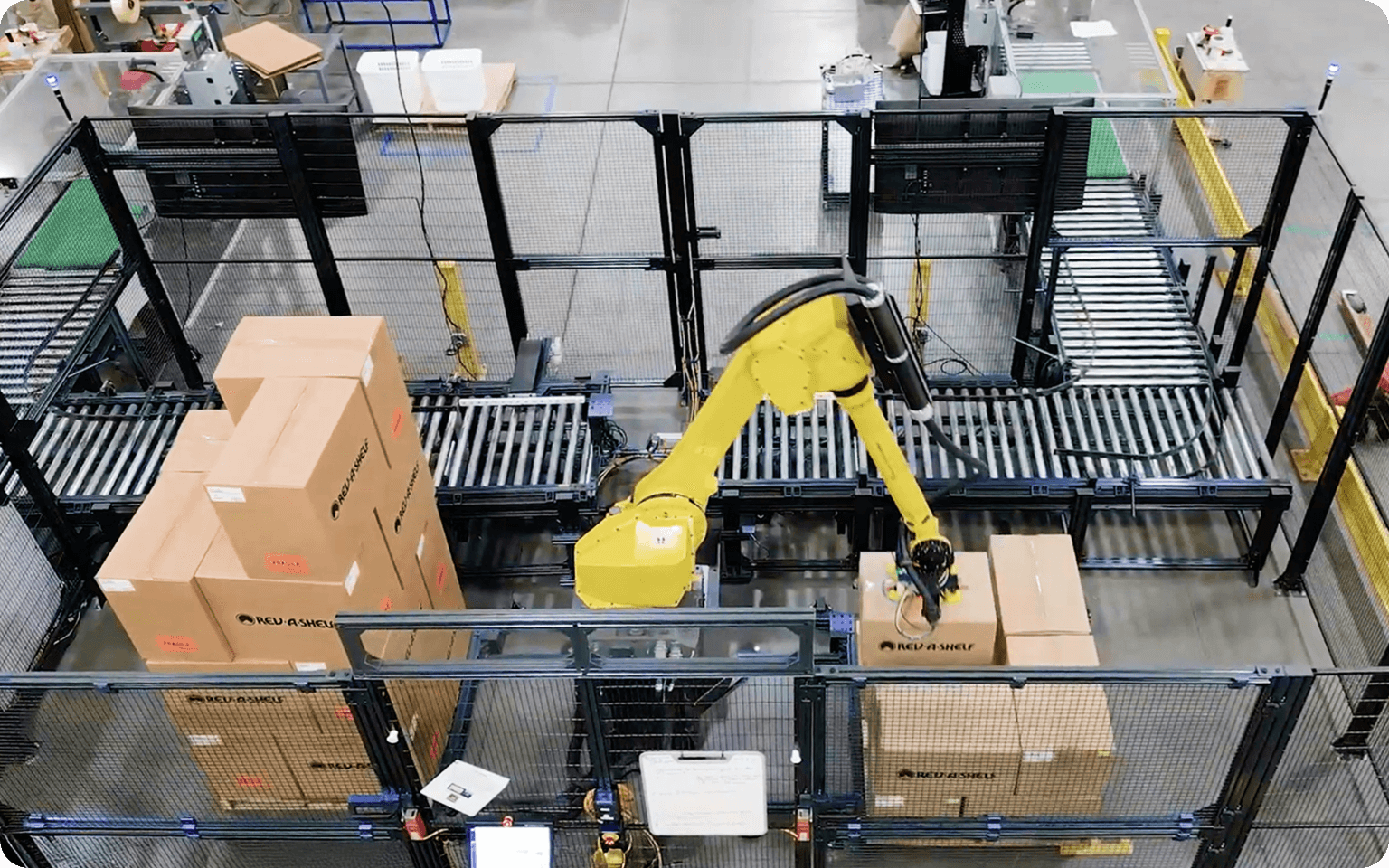
Both collaborative robots (cobots) and industrial robots solve the same problem. But the tradeoffs are different than most manufacturers expect. According to Vention’s Palletizing Automation Buyer’s Guide, cobots and industrial robots both meet impressive cycle times, but industrial palletizers can multipick more. Where cobots can pick one 20kg box, an industrial palletizer can pick from 5 to 7 at once.
Cobots have built a reputation for being the safer, more user-friendly option. Cobots also don’t require bulky fencing, feel compact on the line, and can operate smoothly with people around thanks to their built-in safety features.
Their reputation for ease of use and safety is largely earned. Because of this, many manufacturers default to cobots. Although they appear to be lower risk, the real risk lies in not opting for the industrial robot that could produce greater throughput.
Industrial robots are known for being overly complex and only suited for the largest enterprise companies. But the truth is, they can handle heavier payloads at higher speeds, often doing the work of two cobots at once, and just as safely. In Vention’s case, industrial robots also come with the same easy-to-use interface. If a business is evaluating between two types, it comes down to capacity, floorspace, and line complexity, not safety and user experience.
Additional Palletizer Types
Beyond the cobot vs. industrial palletizer debate, other palletizer types emerge and vary by configuration.
- Single In-Line Palletizers: This is a common and straightforward setup in which one robot handles picking, placing, slip sheet dispensing, and pallet dispensing. These palletizers work across multiple lines and SKUs, but have lower throughput due to the single-use design.
- Layer-Forming Palletizers: This setup incorporates multiple robots working together. One assembles product layers while the other stacks them. This boosts overall efficiency, and some designs mix manual and automated palletizing.
- Mixed-Configuration Palletizers: This is where two or more robots are combined to work in a single cell. A high-speed industrial arm, for example, could stack product while a cobot could dispense slip sheets or apply labels. This method balances flexibility, throughput, and cost when no single palletizing option meets every criterion.
- Cartesian Palletizers: These palletizers operate on the X, Y, and Z axes. They are best for palletizing uniform products, and although they are slower, they can handle heavy payloads. They are cost-effective for simple, low-throughput operations.
- Gantry Palletizers: These palletizers move along one horizontal axis and can take on heavier loads than Cartesian models thanks to their size and design. Gantry models are ideal for tight spaces and high stacking applications.
- 7th Axis Palletizers: These models add an extra axis of movement, expanding the robot’s reach and flexibility. While slower, these palletizers are perfect for lines requiring stability and support for large payloads.
What to Look for When Evaluating Automated Palletizers
Choosing the right palletizer for the production line doesn’t always mean choosing the most advanced option out there. Manufacturers should consider:
- What is being stacked? Boxes, bags, pails, and trays determine gripper selection.
- What are the throughput requirements? The number of items that need palletizing per minute might drive a choice between collaborative and industrial robots.
- What does the floor space and in-house experience look like? Space constraints will impact robot choice, and teams with less robotics experience should consider options with better software support.
- What are the must-have pallet features? Slip sheets, corner boards, fencing, and automatic pallet dispensing will all impact which options are available and will be most effective on the floor.
It’s also important to consider a fragmented versus an end-to-end solution. Vention is the only full-stack automation solution, supporting manufacturers through every stage from design to deployment and monitoring. When SKUs change, throughput grows, or a production line needs expanding, working with one accountable vendor can mean adapting, replicating, and scaling a current system, whereas a patchwork of vendors will force a costly overhaul.
The Choice to Manually Palletize Could Mean Falling Behind
The Manufacturing Institute and National Association of Manufacturers estimate that 2.1 million manufacturing jobs could be vacant by 2030. Robotic palletizing doesn’t mean cutting out additional humans. It means filling those gaps, meeting the demand to ship products faster, and building repeatable, proven processes to scale the business.
Looking to understand how complex your palletizing setup is? Take the quiz and learn more about your ideal palletizer.