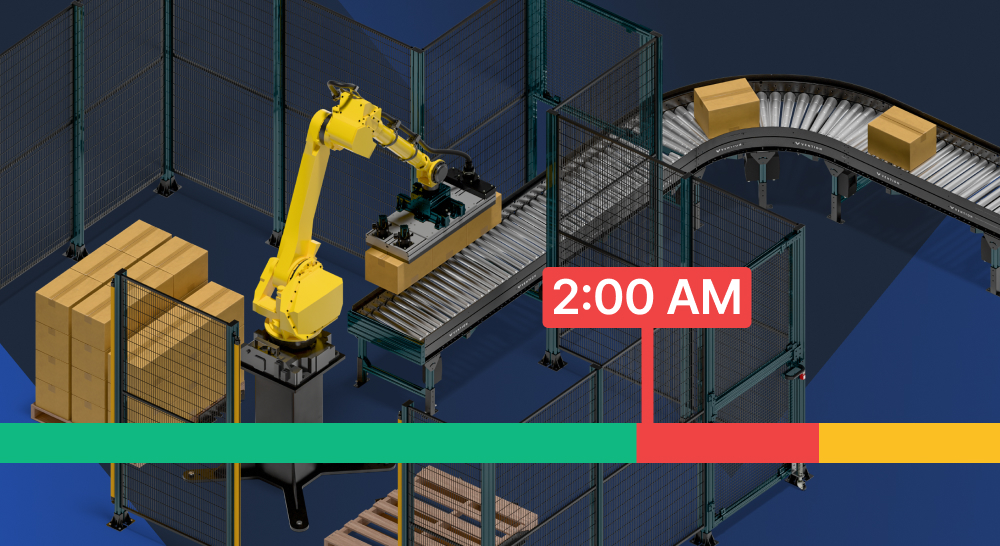
Unplanned downtime costs industrial businesses close to $125,000 an hour, according to ABB’s Value of Reliability survey. That’s $1 million for an eight-hour shift. The same research finds that two-thirds of businesses face unplanned outages at least once a month.
Siemens’ 2024 report estimates unplanned downtime costs the world’s 500 largest companies as much as $1.4 trillion a year or 11% of their revenue.
Outages can happen at any time. During a shift, on a Saturday morning, or over the course of a long weekend. Support coverage often doesn’t. Some vendors now offer 24/7 support, but it usually comes at premium pricing, and buying it often means negotiating a custom SLA with its own quote. Even when available, faced with that cost and process, many plants stay on business-hours coverage. When a palletizer on that plan faults at 2 AM, all a plant manager can do is read the manual and wait for the phone lines to open back up. All while the plant absorbs every hour lost in between.
A palletizer stop is costly because of where it sits. As the last machine of the line, an idle palletizer backs up production upstream. And while 99% uptime is the goal, coverage for the unplanned should be a part of equipment evaluation just as much as payload, throughput, and general budget.
3 Reasons Why Equipment Support Often Falls Short
Most equipment support models start on a limited tier that covers business hours. Equipment is sold, teams are trained during integration, and finally, the vendor provides a manual and a support line number for future troubleshooting. Round-the-clock coverage is usually exclusive to higher tiers that the plant has to choose and pay for.
On a base plan, teams are well covered between 9 AM and 5 PM. Outside those hours, three things tend to go wrong.
- After hours, the people who know the equipment best are not on site. Maintenance leads and the engineers who commissioned the cell usually work day shifts. Third shift workers and weekend crews are well trained to keep the line running, but not to troubleshoot it when it stops.
- 24/7 coverage is hard to access. Large automation vendors and the biggest integrators offer 24/7 support, but often as a custom contract with its own SLA and quote, often with budget-shifting price points. Smaller integrators often can’t staff it at all. One study of 4,290 system integrators found that 68% have fewer than 50 employees. For a plant comparing equipment bids, that extra cost and negotiation becomes easy to defer, and the plant goes live on business-hours coverage only.
- The plant cannot fill the gap itself. 98.6% of US manufacturers are small businesses. Smaller operations rarely employ full-time robotics specialists, so anything beyond routine operation will require vendor support.
A palletizer that stops at 2 AM on Saturday can sit idle for 55 hours waiting for support at 9 AM Monday. With 24/7 support, the same fault can be cleared in about 20 minutes.
Checklist: What to Ask Equipment Vendors About After-Hours Support
During scoping, vendors and integrators will cover how a palletizer works and what it can do when it runs. The following checklist is key to understand how your team will be supported when it doesn’t:
- Overnight support: Who answers a support call at 2 AM on a Saturday? Look for a named team with live coverage and expected response time. A voicemail returned on Monday is not a response.
- How to access: A tier you can add like any other subscription is faster to put in place than an SLA that has to be scoped and quoted.
- Tier mobility: Coverage needs change as lines are added or shifts are extended. Moving between tiers without renegotiating keeps support matched to the operation.
- Visibility: How can the expert see what they’re dealing with? Live video, connected machine data, and logs let the support expert diagnose the issue directly, instead of relying on a description over the phone.
- Remote accessibility: Can the expert access the system remotely to fix the issue, or will they have to guide the operator through it?
- Customer satisfaction: Proof points show how often a fault can be fixed during the call before turning into a ticket for an onsite visit.
- Part availability: If the failure is identified as a hardware issue, how quickly are replacements identified and ordered?
How Vention’s 24/7 Remote Support Works
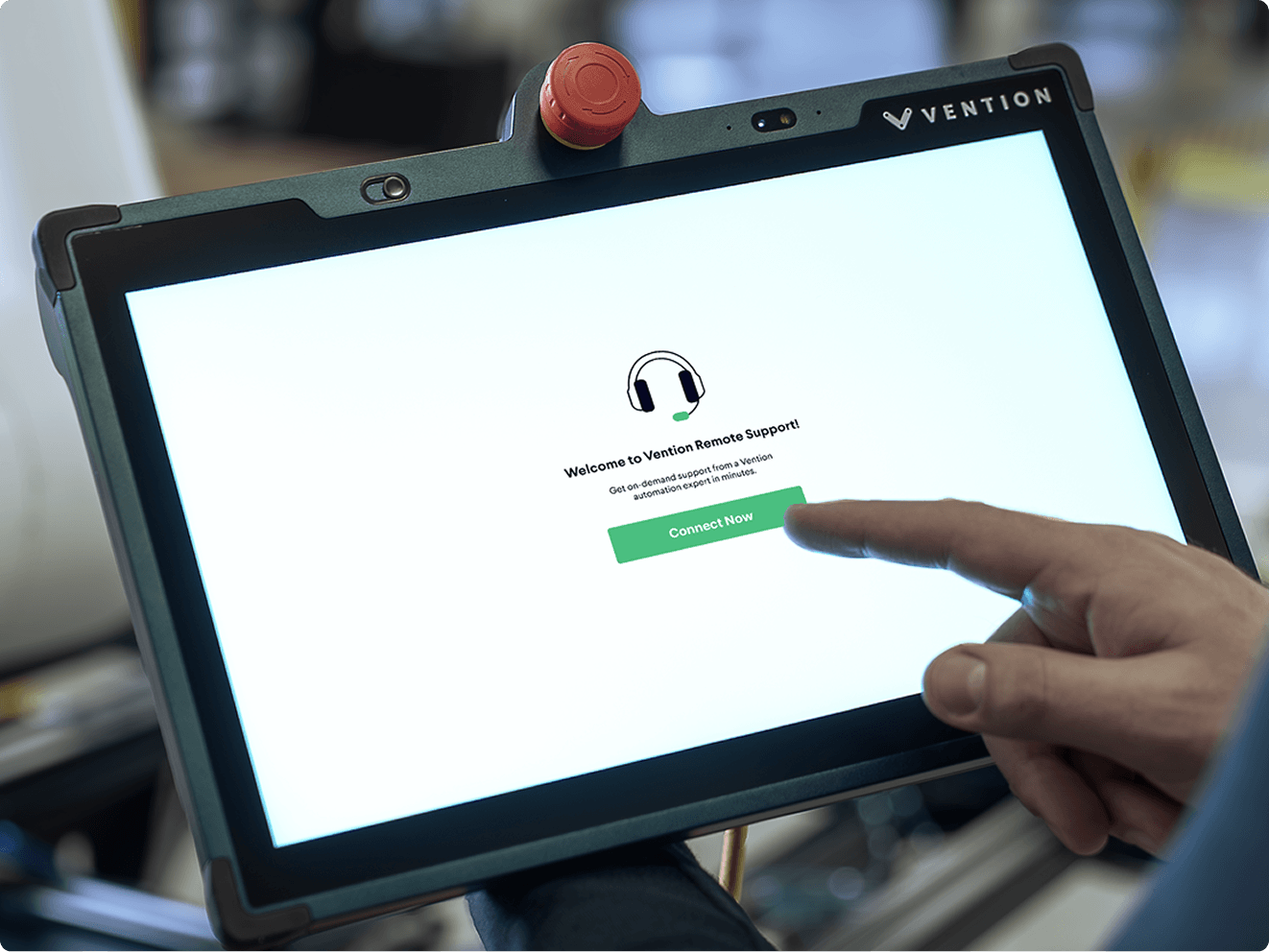
Vention’s support model responds to these questions. The newly launched 24/7 Remote Support connects your plant to a Vention expert, always available within a 10-minute response time Service Level Agreement (SLA).
Through Vention’s Priority Care 24/7 plan, three tools work together when a plant calls for help:
- Remote Support 24/7: A Vention expert is available at any hour with current average connect time sitting under 2 minutes.
- MachineAnalytics: The expert can see the cell’s uptime, Overall Equipment Effectiveness (OEE), downtime, and fault data, and so they start the call already knowing what stopped and when.
- Remote View: Live stream and recorded playback of up to seven days of machine activity, based on machine logs, so the expert can replay what the cell was doing in the moments before it faulted, as well as test the applied solutions with live footage.
Together, these tools mean the expert doesn’t have to rely on a description of the fault over the phone. If the fix requires changes to the machine, Remote Access lets the expert, with the plant’s permission, correct the code directly.
If the issue is at the hardware level, the failed part is identified, and the replacement is ordered. Most Vention hardware is available off the shelf for next-day shipping. Bigger components, like specific conveyors may require a few weeks.
Current data shows 90% of the cases are solved remotely. Onsite support, however, remains available for when a problem calls for it. For a plant, this means faster problem resolution, higher uptime, and more production, making the most out of the same piece of equipment.
Make Uptime Part of the Purchase Decision
Factories already consider Overall Equipment Effectiveness (OEE) at the time of purchase. The support model behind a machine should be included in this metric. Because when a palletizer goes down at 2 AM, the costs depend less on what the issue was and more on how quickly it could be fixed to get the machine back up and running.
Learn more about Vention’s 24/7 Remote Support