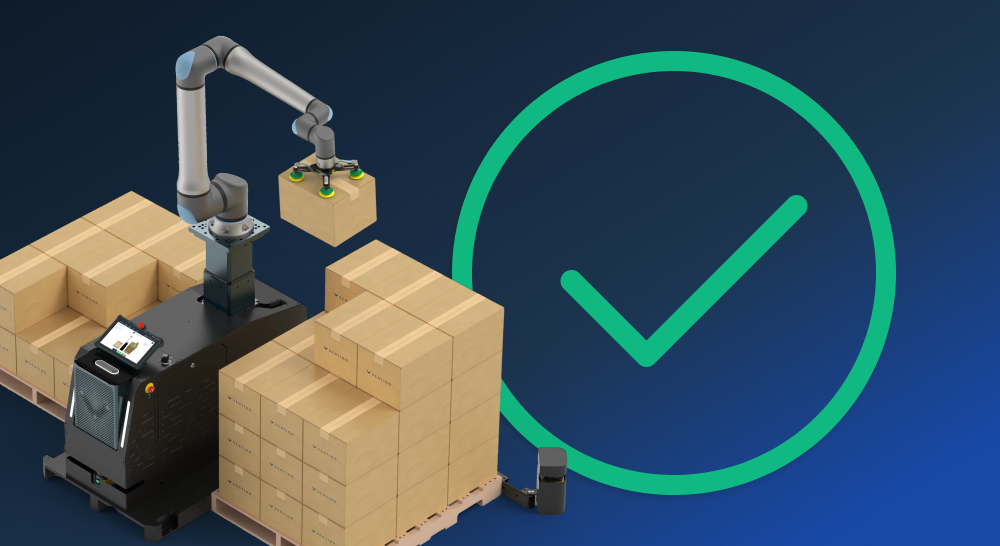
Investing in an automated palletizer is a common strategy for manufacturers looking to improve their end-of-line efficiency. More often than not, manufacturers choose the cheapest, bare-bones option on the market. If it’s a step above manual palletizing, according to many, it’s a step in the right direction.
But quick automation decisions result in buying regrets down the road. Here’s what to consider before automating your palletizing process, so you can feel confident in your evaluation and future production line.
Why Palletizer Automation Is on the Rise
Manual palletizing involves increasing overhead spend and training employees to do physically demanding work. Repeated twisting, bending, and lifting causes increased injury rates, sick time, and turnover.
Automated palletizing, however, means robots take on that work. Yes, there’s an initial upfront investment, but no injuries, vacation time, onboarding, or labor shortage to navigate once systems are live. Palletizing robots have also recently become safer and easier to operate. Switching between SKUs, adding steps like slip sheets, and having the robots work in collaboration with people are all now par for the course in the world of automation.
6 Common Buying Regrets When Implementing an Automated Palletizer
1. Buying on Price, Not Total Cost of Ownership
Perhaps the most common mistake is to opt for the quote that looks best on paper. Many assume that the cheapest robot offers the fastest payback period, but if an inexpensive robot fails to meet throughput or cycle time requirements, the ROI is further away than you’d think.
With a palletizer properly spec’d to your use case, the typical payback period could be 12 to 18 months. In most cases, the slightly higher price equates to a better total cost of ownership.
2. Underestimating Safety and Guarding Needs
Safety requirements aren’t a simple checkbox. The right configuration of light curtains, sensors, hard guarding, and fencing always differ depending on robot type and performance. Some software solutions also equip palletizers with part context, where the system knows all surrounding pieces in a given line, thereby making movements and workflow.
By failing to consider the end-of-line workflow in its entirety, manufacturers often discover safety risks mid-installation. This results in costly rework, last-minute safety equipment purchases, or potentially different or additional robot parts to keep the whole system compliant.
3. Believing the Cobot vs. Industrial Palletizer Myths
Collaborative robots (Cobots) are small robots designed to work with humans. So they must be safer and easier to operate than industrials, right?
It’s an assumption many manufacturers make that leads to inefficient systems. The truth is, the right choice comes down to the software, interface, and support. Solutions like Vention offer the same simple UI for operating cobots and industrial robots. Consider what your actual payload and throughput needs are, and you might find that an industrial robot is a better fit than the cobot you had your eye on.
4. Not Future-Proofing for New SKUs or Products
A palletizer scoped tightly for today’s production needs becomes a bottleneck as soon as a new product or pallet pattern comes along. Buyers who consider not just their current requirements, but future growth plans are in the best position to buy the right palletizer. Flexibility built in from day one costs less than adjusting down the road.
5. Overlooking the Workflow Around the Palletizer
Thinking about the palletizer itself is a given, but configuring everything around it is what most people forget. If there are space constraints, heavy foot traffic, or a layout that hasn’t been tested under real conditions, it’s going to stall safe deployment.
A detailed assessment and simulation of the final system before go-live will catch conflicts early, before they turn into issues to troubleshoot.
6. Choosing a Platform Without Reliable Service and Support
Even the best out-of-the-box palletizer needs upkeep, and most automation teams lean on their vendors for it.
Quarterly or even monthly preventative maintenance keeps downtime rates low. Beyond maintenance, quick response times for sudden issues matter. Ask your vendors about their remote support options, live-feed monitoring or camera access, and annual service packages before signing.
Things to Consider While Evaluating Palletizing Solutions
To avoid some of the common buyer regrets, manufacturers should consider the following during evaluation:
-
What types of products are being stacked? Bags, pails, and boxes will determine your grippers.
-
What are the throughput requirements? The number of items that need to be palletized per minute will guide your selection.
-
What does the current workflow and available floor space look like? Space constraints and high traffic at the end of the production line will inform robot type and some safety must-haves.
-
What additional pallet features do you need? Corner boards, slip sheets, and fencing will all help you determine the right robot the first time.
-
Are there on-demand support options? Having a service team at the ready when it’s time to troubleshoot could save hours diagnosing issues manually.
-
Is the vendor a full-stack, end-to-end solution? Vention is the only automation solution that helps manufacturers from initial concept to post-deployment. When throughput grows, SKUs change, and production increases, it acts as one accountable vendor to scale your current system.
End-Of-Line Automation is Only the Beginning
Investing in reliable, scalable palletizer automation is one way manufacturers maintain a competitive edge. But rushing into vendor decisions often creates blockers after deployment. To avoid regretting your purchase down the road, it’s important to partner with the right experts from the start.
Take the palletizer complexity quiz to learn more about your ideal configuration