Today, the image of industrial robotics in aerospace and defense manufacturing still defaults to an industrial FANUC arm drilling fuselage panels or an automated fiber placement head laying composite tape. That picture, while well known, is incomplete and outdated.
Robotic automation is gaining traction across defense primes, Tier 1 suppliers, and a new generation of defense hardware companies. And the shift doesn’t come from the technology being new, but because the economics and deployment speed have changed.
This article details a modern map of where robotics is being deployed in the aerospace and defense sector today.
7 Areas Where Aerospace and Defense Automation is Being Deployed Today
1. Structural Drilling and Fastening
Structural drilling and fastening is one of the most mature robotics applications. Airbus uses automated drilling and fastening systems for its A350 assembly. Northrop Grumman collaborated with KUKA Systems to develop an Integrated Assembly Line for F-35 fuselage manufacturing, using automation throughput with aerospace precision. These systems reach sub-millimeter positional accuracy and greatly reduce defects when compared to manual operations.
The ROI case for high-volume assembly is clear. The new trend is extending these capabilities to lower-volume, higher-mix programs where automation is now economically viable.
2. Machine Tending
CNC machining has always been labor-dependent across aerospace and defense supplier operations. Mobile cobot machine-tending cells are increasing feasibility, particularly in high-mix environments where one fixed robot per machine is difficult to justify.
Harris RCS, a UK-based aerospace supplier, deployed a mobile cobot tending cell with Vention, for example. The cobot serves multiple machines and handles up to three changeovers per day across batch sizes from 5 to 2,000 units. Post-deployment, the cell consistently outperforms daily production targets by 28% while reducing scrap rates. And since one cobot covers multiple machines, ROI improves over the fixed installations approach.
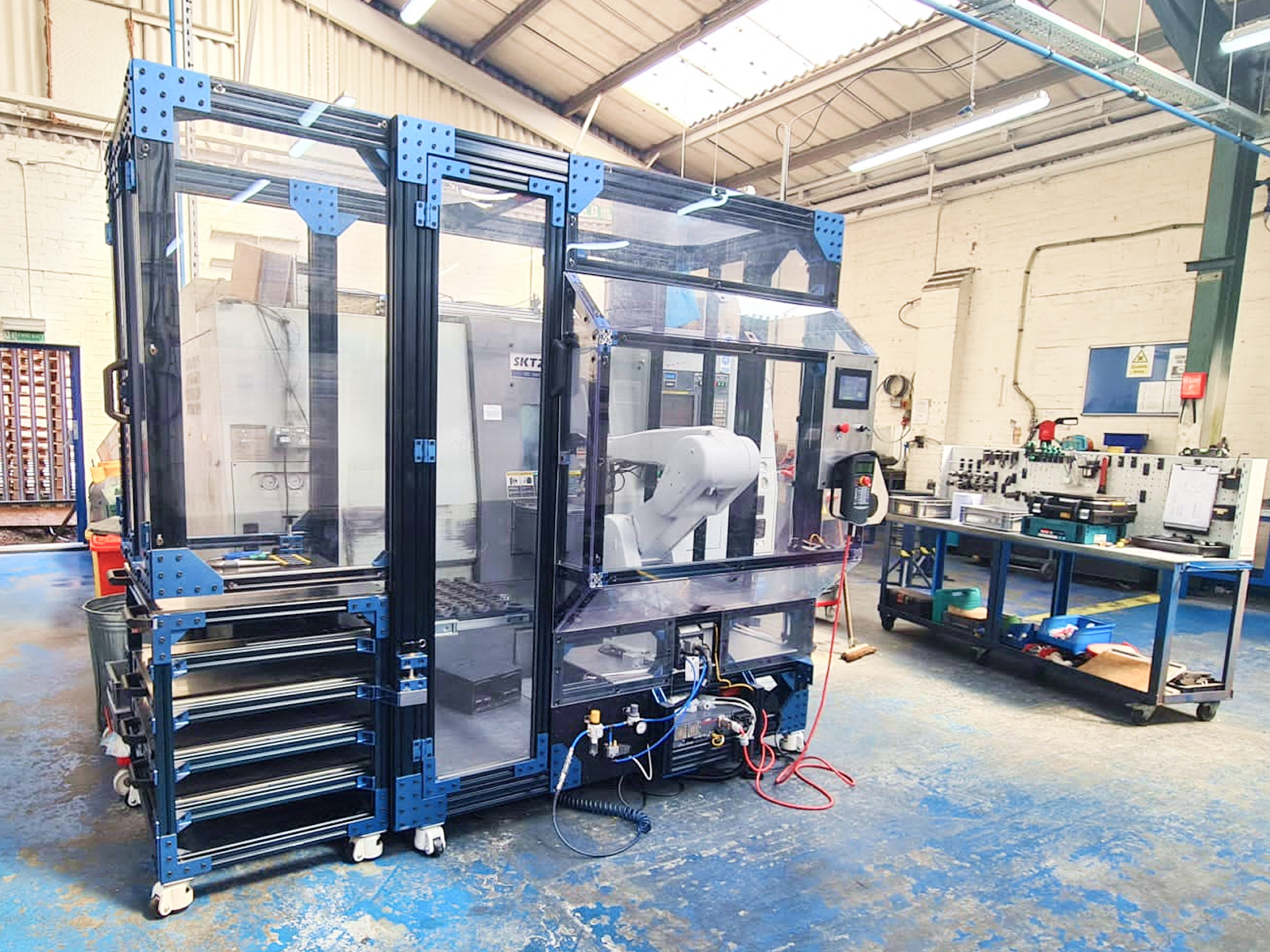
At the higher end, aerospace titanium machining cells are increasingly running lights-out for 16 or more hours per shift. This pallet-based automation removes the need for operators on site between setups.
3. Surface Finishing
Sanding, grinding, and deburring composite and metal components are some of the most physically demanding tasks on the aerospace production floor. They also require consistent force application across complex geometries, which is a problem collaborative robots are well-suited to solve.
Collaborative robots now handle composites sanding on aerospace panels, applying consistent force across curved surfaces while adapting in real time to variations in the part’s profile. This reduces dust exposure and vibration fatigue for workers, and maintains finish quality from the first part to the last.
4. Material Handling and Transport
Mobile robots are being increasingly used for aerospace and defense products. Pratt & Whitney has deployed autonomous mobile platforms for material handling in engine production, meaning components move dynamically between stations instead of by fixed conveyor path. Boeing uses AGVs to move large composite assemblies at its Composite Wing Center.
The difference is flexibility. AMRs can re-route as production configurations change, and fixed conveyors cannot. The global AMR market is growing at a projected 15% CAGR through 2030, and aerospace and defense manufacturers are one of the leading adoption sectors as the demand for faster, more adaptable material handling rises.
5. Automated Testing
Electronic and functional testing of avionics, PCBs, and mission systems is a high-frequency, high-stakes operation. Automated test equipment integrated with robotic handlers runs testing at line speed with traceability, while meeting ITAR and MIL-SPEC requirements. Robotic test fixtures connect and reconnect to boards and assemblies without manual probe placement. This leads to reduced cycle times and no handling failures.
The semiconductor and electronics sectors saw an 18% surge in robot orders in Q2 2025, which is partly expected to support the defense space. This increase is also partly driven by guided systems components feeding production ramps and demand for higher test throughput on avionics.
6. Custom Material Handling
Some aerospace manufacturing processes involve components so fragile or geometrically specific that standard automation cannot handle them. These custom materials represent some of the highest-value automation opportunities today.
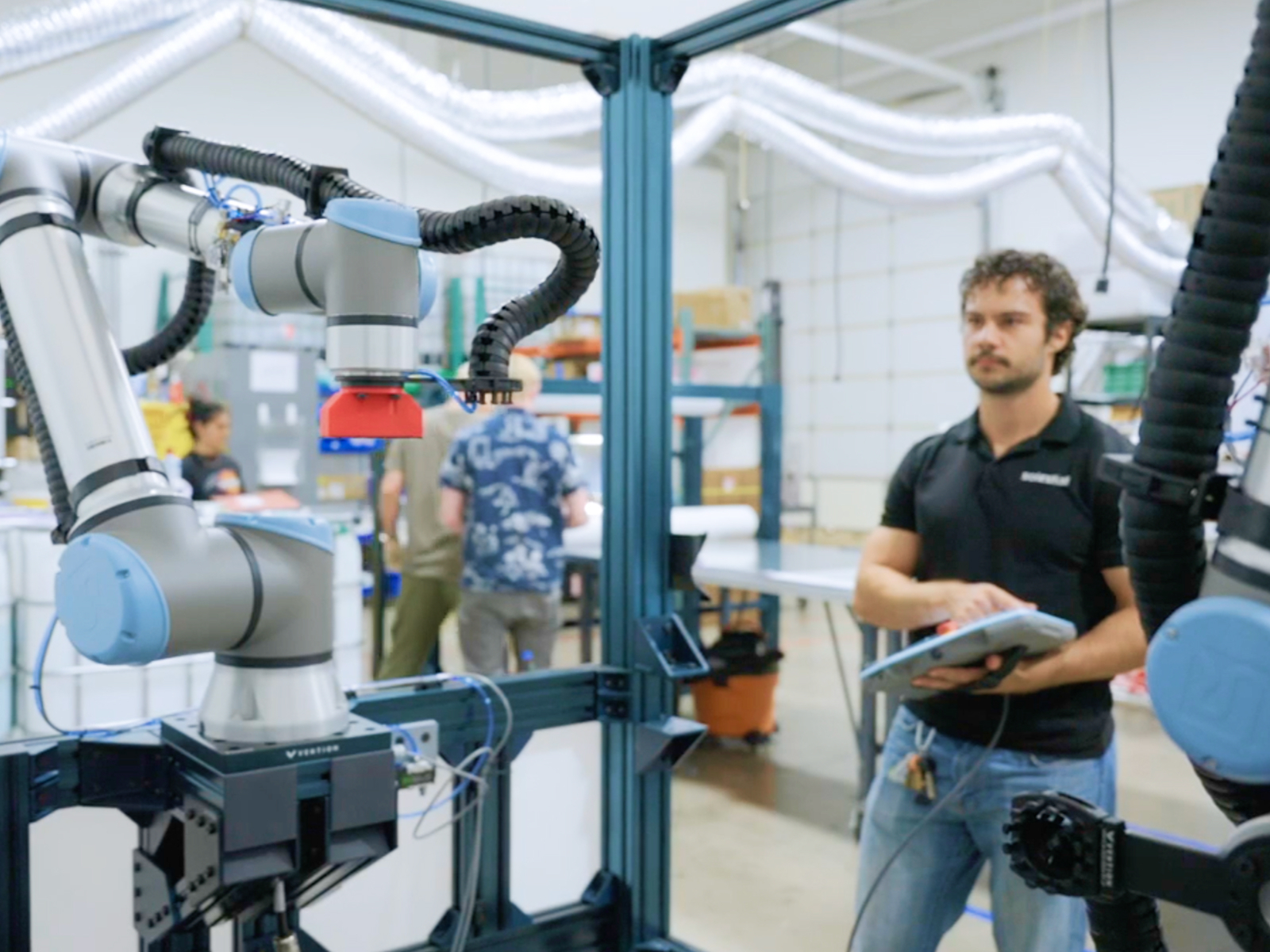
Space-grade solar cell manufacturer Solestial needed to automate handling of ultra-thin silicon wafers that fracture under conventional pick-and-place forces. With Vention, they deployed a custom gantry system for wafer loading in just four weeks. The result was a 50% increase in throughput while maintaining the precise handling the process required. Physics-based simulation also validated the motion paths before equipment was ordered, so the team didn’t risk reworking or compromising deployment time.
The same platform was later applied to Solestial’s wet-etch hoods. Both use cases prove that a modular automation platform can handle multiple custom applications within a single facility. No continuous engineering engagement needed.
7. Inspection and Non-Destructive Testing
In factory settings, AI-powered vision systems deliver over 95% defect detection accuracy on aerospace components according to ScienceDirect. Gecko Robotics was recently awarded a $54 million Navy contract to deploy AI and robotics for inspecting U.S. Pacific Fleet vessels, increasing defect identification time by up to 50 times. Delta Air Lines received FAA authorization for drone-based inspection across its Airbus and Boeing fleet, with plans to scale through 2026.
The value driver is always speed and consistency of detection. Manual inspection at production rates in missile and satellite programs is consistently both a throughput constraint and a quality concern.
The Map Is Just the Starting Point
A supplier running a lights-out machining cell may still have manual sanding operations three workstations away. A prime with a fully automated drilling line may rely on manual technicians for inspection and testing. Automation opportunities are everywhere, and deployment is now more intuitive and accessible than ever.
To learn more about end-to-end automation in the aerospace and defense industry, check out Vention’s industry page.