The AI trend in manufacturing was on full display at IMTS 2026. Agentic AI helped teams design, program, and operate automation from simple prompts and plain-language instructions. Physical AI let robots perceive parts, plan grasps, and compute their own collision-free paths.
Both ran on a single platform powered by a new era: AI-Defined Automation. And Vention is at the forefront.
Here is what visitors saw at McCormick Place, booth 236860.
What Is AI-Defined Automation?
AI-Defined Automation is an emerging approach to industrial automation that puts intelligence at every layer of the stack, from how a system is designed to how it runs.
It extends the Software-Defined Automation platform Vention has offered from the start. With hardware, motion control, and cloud connectivity already integrated, Vention now adds two complementary forms of AI on top.
| Agentic AI | Physical AI | |
|---|---|---|
| Where it works | The digital level of an automation project lifecycle: design, programming, and monitoring | The physical level: the robot and its cell |
| What it does | Interprets plain-language requirements, generates cell layouts and code, and diagnoses issues from machine data | Perceives parts, computes grasp points, and plans collision-free motion without manual programming |
Agentic AI at IMTS 2026: MachineAgent From Design to Operation
Most automation demos show AI at a single step. The MachineAgent station showed it across three: design a cell, program it, and monitor it.
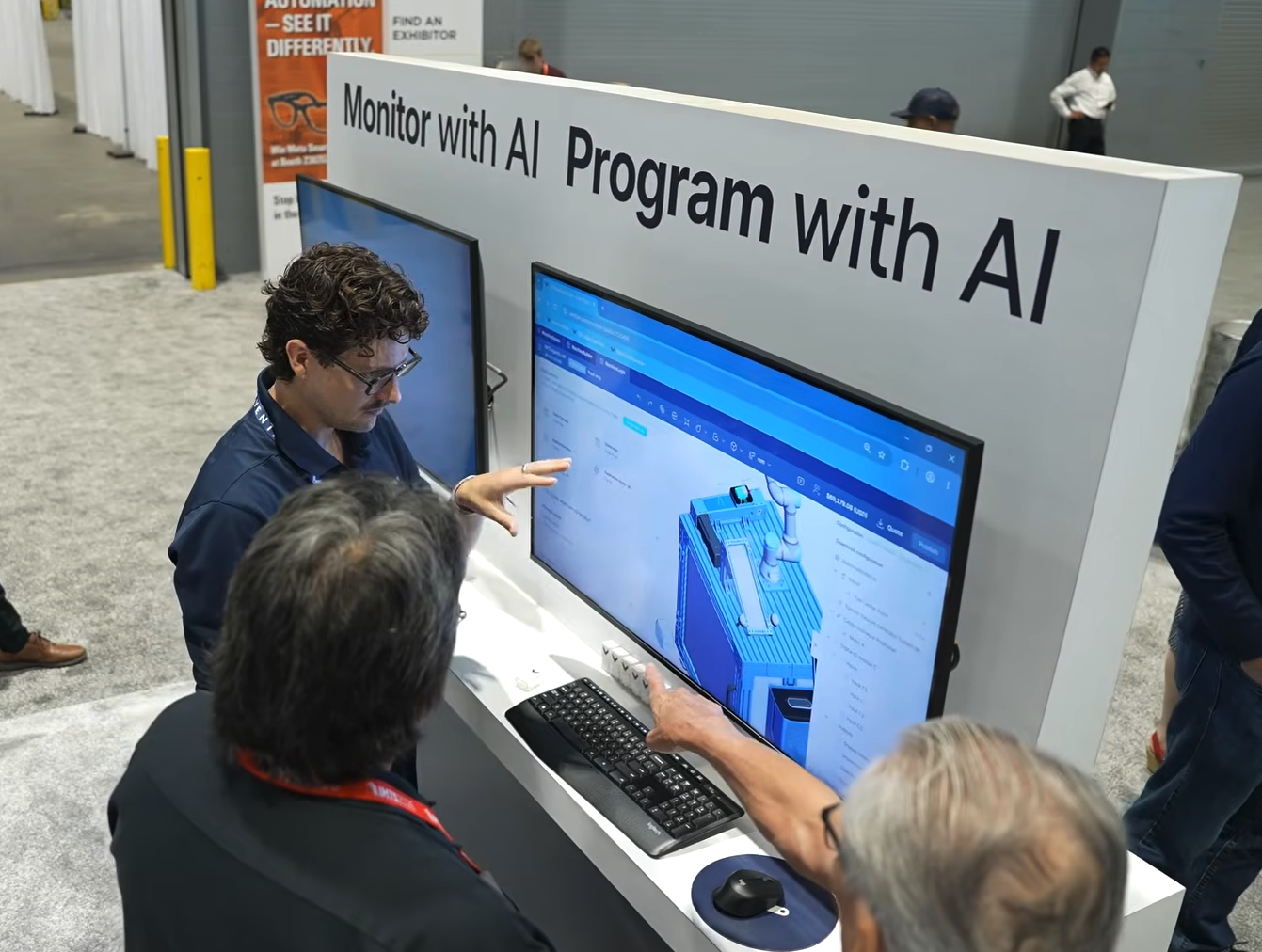
Four screens and a UR3 candy-picking cell walked visitors through the full lifecycle, and for the first time, Agentic AI programmed a robot live in both the digital and physical worlds.
Design a Cell From a Photo and a Spec
The first screen started with an uploaded shop-floor photo and a detailed plain-language spec. Claude Desktop (Cowork) turned them into a complete MachineBuilder floorplan. In one example, it placed Rapid Operator AI cells, workstations, and shelving in front of each CNC machine. In another, it routed an industrial palletizer and conveyors around a packaging line’s pillars and walkways.
Every layout used standard Vention products, which means the output is orderable rather than a concept sketch.
Program Two Ways: Local IDE or In-Platform Copilot
MachineAgent gives teams two programming paths, depending on how they prefer to work.
- Local IDE: A developer runs an AI agent such as Claude Code in their own IDE. The Vention CLI and Developer Toolkit 2.0 provide the project structure. The engineer links the IDE to Vention Cloud with vention pull, feeds the agent the system requirements document, builds the application, then syncs back with vention push to verify it in simulation.
- MachineLogic Copilot: On two interactive screens, visitors programmed the UR3 themselves in the platform. They described the task, simulated the program against the digital twin, then deployed it to the physical cell on the show floor.
Both paths end in the same place: a program validated in simulation before any motion on the floor.
Operate: Fleet Analytics and Troubleshooting in Plain Language
The fourth screen showed Claude Desktop (Cowork) start at a fleet dashboard of five to six deployed palletizers. It then produced an Overall Equipment Effectiveness (OEE) summary for one plant, with charts and data, and flagged the lowest-performing unit. When asked to troubleshoot it, the agent diagnosed an intermittent robot reset and walked through the fix.
What’s New in the Vention CLI and Developer Toolkit 2.0
The local programming path runs on two updates announced at IMTS. The Vention CLI is now context-aware: AI agents can read a machine’s configuration and scene assets to write applications tailored to that exact setup. A new logs command lets developers diagnose and iterate on issues from the terminal.
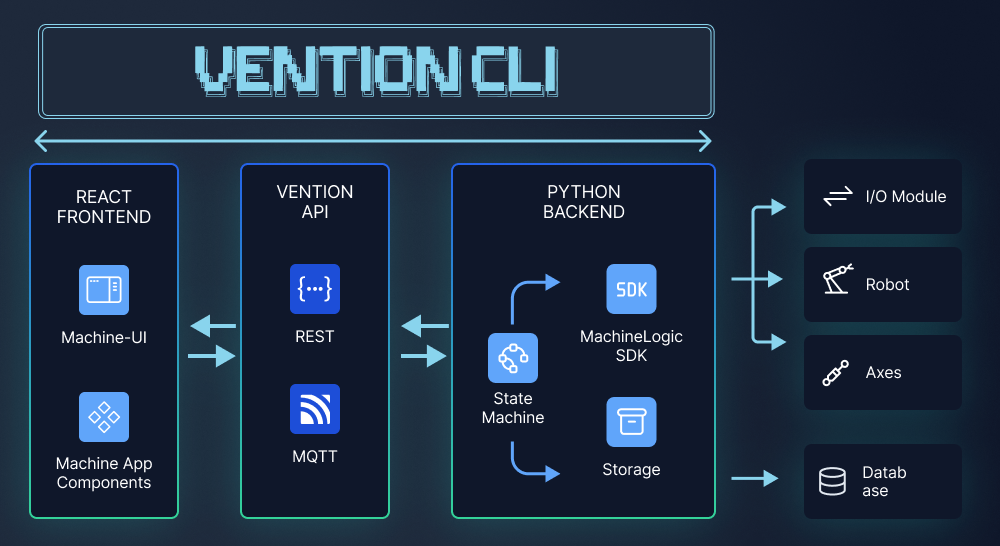
The Vention Developer Toolkit 2.0 also goes deeper:
- State Machine: Runs instructions on state entry and exit.
- Storage: Handles schema migrations, with filtering and pagination built in.
- Communication: Offers integrated OpenAPI support, enabling generated clients and typed API consumption. Your environment knows the exact shape of the data your API requires before running the code, helping catch errors early.
- MachineUI: Adds new components to build with.
- MachineApp: Now supports widgets, pages, password protection, and multiple languages.
The result is a workflow developers already know: pull, build, push, and deploy from their own environment. The full CLI and VDT 2.0 announcement covers each update in detail.
Physical AI at IMTS 2026: Robots That Adapt to the Floor
Agentic AI speeds up the people building automation. Physical AI changes what the robot can handle once it runs. Every demo in this part of the booth ran on MachineMotion AI and was programmed through MachineLogic, the same stack behind the MachineAgent station.
Rapid Operator AI: Deep Bin Picking on a UR12e
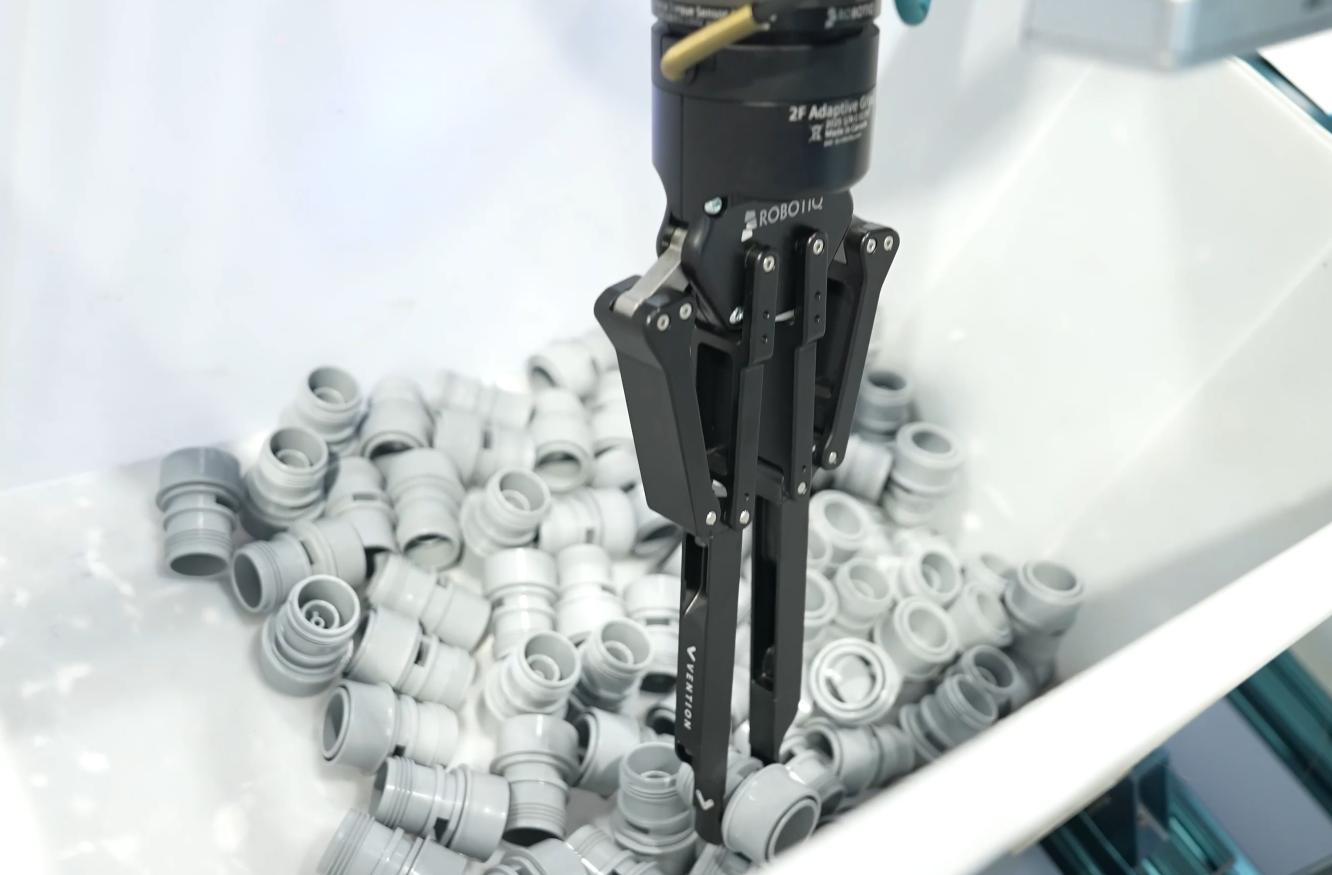
Rapid Operator AI is Vention’s turnkey AI deep bin-picking system for unstructured environments. At IMTS it ran on a Universal Robots UR12e with a two-finger industrial gripper, AI vision from Luxonis, and a MachineMotion AI controller.
The system is powered by GRIIP™ (Vention’s Generalized Robotic Industrial Intelligence Pipeline) and NVIDIA Isaac foundation models. It handled real-time part detection, 6-DoF pose estimation, collision-free grasp planning, and adaptive retries in bins up to 24 inches deep.
Most importantly for production is the simplified onboarding. New SKUs are added from a CAD file, with no model retraining, and Vention rates the system at up to 99% first-pick success for continuous operation across shifts.
Collision-Free Path Planning on a FANUC LR Mate
The industrial demo paired a FANUC LR Mate with Vention’s goal-oriented motion capability. Operators set a start and end target. The system scanned the workspace with on-arm vision, built a digital twin in the cloud, and computed the collision-free path between the two points without intermediate waypoints.
For machine tending and mixed-SKU pick-and-place, removing waypoint programming means a line can adapt to new SKUs, fixtures, and layouts in minutes rather than weeks.
The Platform Behind the Demos
Every demo at the booth ran on the same foundation: modular Vention hardware, a single MachineMotion AI controller, and one software platform connecting them. Four stations put that layer front and center.
Click & Customize Machine Tending on a FANUC CRX-10iA
Vention’s Click & Customize Machine Tending solution automates loading and unloading of CNC machines so operators can move to higher-value work. It sits between rigid turnkey systems and costly custom builds: configurable, fast to deploy, and priced for machine shops. At IMTS, it ran on a FANUC CRX-10iA, with a range of grippers and end-of-arm tools available.
Overhead Range Extender for Welding on a UR20
A UR20 mounted on an overhead 7th-axis range extender ran a live welding application, giving the cobot the reach for large parts in a tight footprint. Welding was the showcase, but the same setup supports:
- Machine tending: Across multiple stations
- Pick and place: Along long conveyor lines
- Assembly: On large fixtures
MachineMotion AI: One Controller, Up to 20 Motors
The range extender, its motors, and actuators all ran on a single MachineMotion AI controller. It daisy-chains up to 20 motors without bulky cabinets or complex wiring. An onboard NVIDIA GPU brings AI to the edge for vision and advanced motion, and cloud connectivity supports remote programming, OTA updates, analytics, and support. It is Vention’s most powerful MachineMotion controller to date.
One Software Platform From Design to Operation
Finally, the booth also ran live walkthroughs of Vention’s Manufacturing Automation Platform, the Software-Defined Automation layer that ties every station together and makes AI-Defined Automation possible. On it, visitors could follow a cell through the full Design, Simulate, Deploy, and Operate journey, without ever having to leave the platform.
Next Stop: PACK EXPO International 2026
IMTS marked the shift from Software-Defined to AI-Defined Automation for Vention. Agentic AI took on design, programming, and troubleshooting. Physical AI took on the parts and paths that used to break rigid systems. Both ran on one platform, which is what turns a strong demo into something a plant can replicate across lines and sites.
The next test is at the end of the line. At PACK EXPO International, October 18 to 21 at McCormick Place, booth N-4730, in Chicago, Vention will show palletizing without the what-ifs: any product today, any change tomorrow.
For a closer look at the developer workflow behind the MachineAgent demo, read the Vention CLI and Developer Toolkit 2.0 announcement.