The clearest signal from Automate 2026 was that the debate over whether Physical AI can work on the real floor is effectively settled. A wave of proven pilots, including Vention’s own AI bin-picking demo, has shown that autonomous AI is here to stay. The conversation has moved on to software-defined automation as the foundation for scaling AI on the factory floor.
Scaling automation across a floor demands a common layer where hardware, software, motion, and AI already speak the same language, otherwise every new cell becomes a custom build and the timeline math falls apart. Vention showed what that unified platform looks like through expansion of Vention’s partner ecosystem, new demos highlighting the capabilities of the platform and thought leadership.
Here is why software-defined automation was the biggest story from the show.
Vention’s Partner Ecosystem at Automate 2026
As Vention builds the largest ecosystem for robotics, demos at partner booths highlighted the growing footprint of software-defined automation.
Expanding the Partnership with Universal Robots
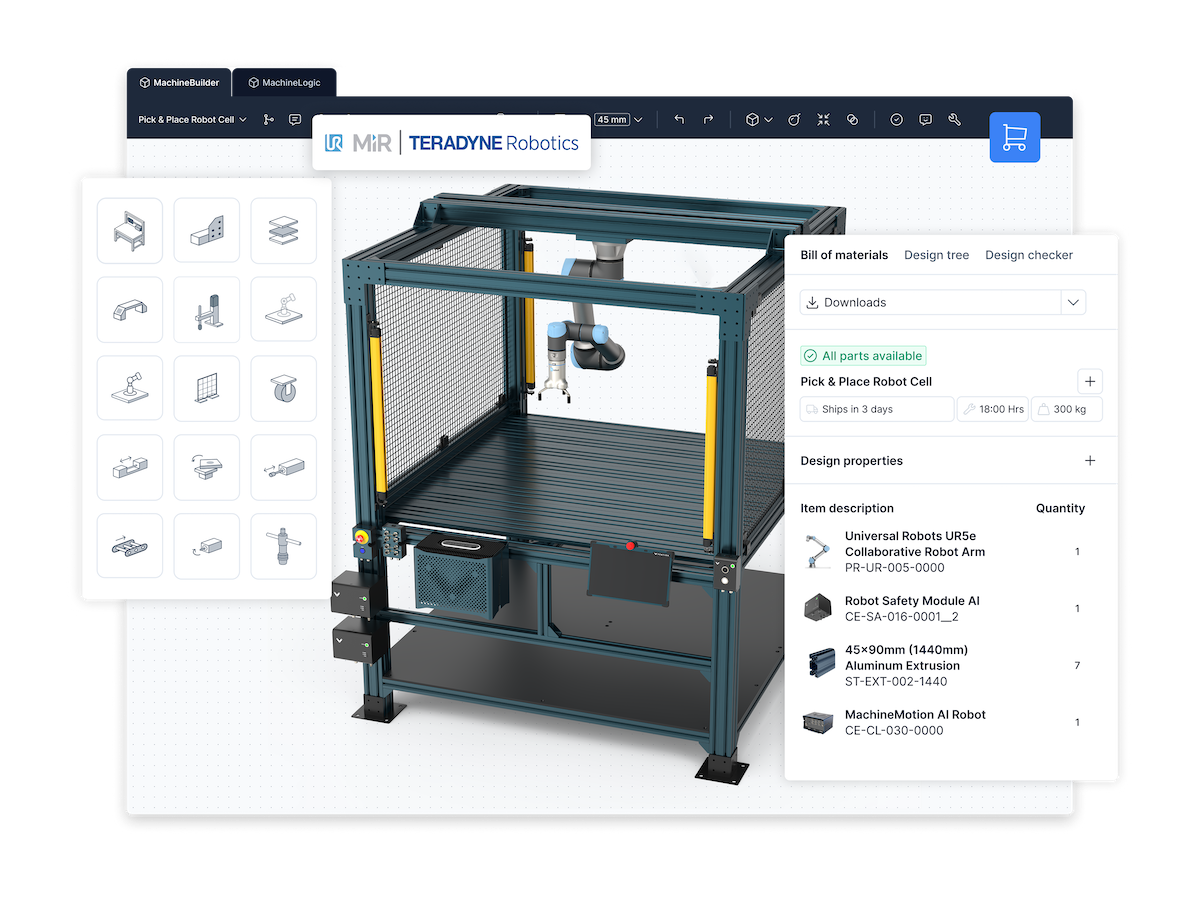
At the Universal Robots (UR) booth, UR showcased Vention’s Rapid Operator AI deep bin-picking application on a UR12e cobot alongside the more strategic piece: a new digital twin creation platform for robotic work cells. Built on Vention’s MachineBuilder and MachinePortal platforms through a strategic collaboration with Teradyne Robotics, it gives UR sales teams and their customers a co-branded environment to design, configure, and quote a UR automation cell end to end, using an exclusive marketplace of UR+ components and pre-configured templates for high-demand applications like machine tending, palletizing, and welding. You can design custom pedestals, adjust your framing, and validate real-world kinematics in a unified digital environment - before a single bolt is tightened.
FANUC and Vention Advance Industrial Robotics
Vention has long championed collaborative robotics and will continue to do so, but Automate 2026 marked its step into industrial automation. At the Vention booth, visitors saw the live demonstration of how industrial robot cells can now be programmed via code-free, Python or assisted with the AI Copilot. Visitors also saw the collision-free path planning for robot motion in action. The FANUC LR Mate ran high-speed industrial tending programmed entirely in the cloud. At the FANUC booth, a CRX-10iA integrated with MachineMotion AI ran a machine tending application built for simplified deployment and faster CNC automation. For machine shops that collaborative robots alone could never handle, running FANUC’s industrial arms and Vention’s cobots in one programming environment means a single way to deploy and manage both, rather than stitching together separate systems and toolchains.
The Floor Runs on Vention: Six Demos, One Platform
Across most factories, automation systems are connected at a process level but run on separate architectures, which creates isolated deployments and translation workarounds that eat into ROI before a system is even live. Software-defined automation brings everything, from motion control and robotics to vision and cloud connectivity, onto a single stack, ready for AI to add intelligence to every facet of automation.
Vention demonstrated this through six demos at Automate 2026, each powered by an MachineMotion™ AI controller.
Collision-Free Path Planning on a FANUC LR Mate
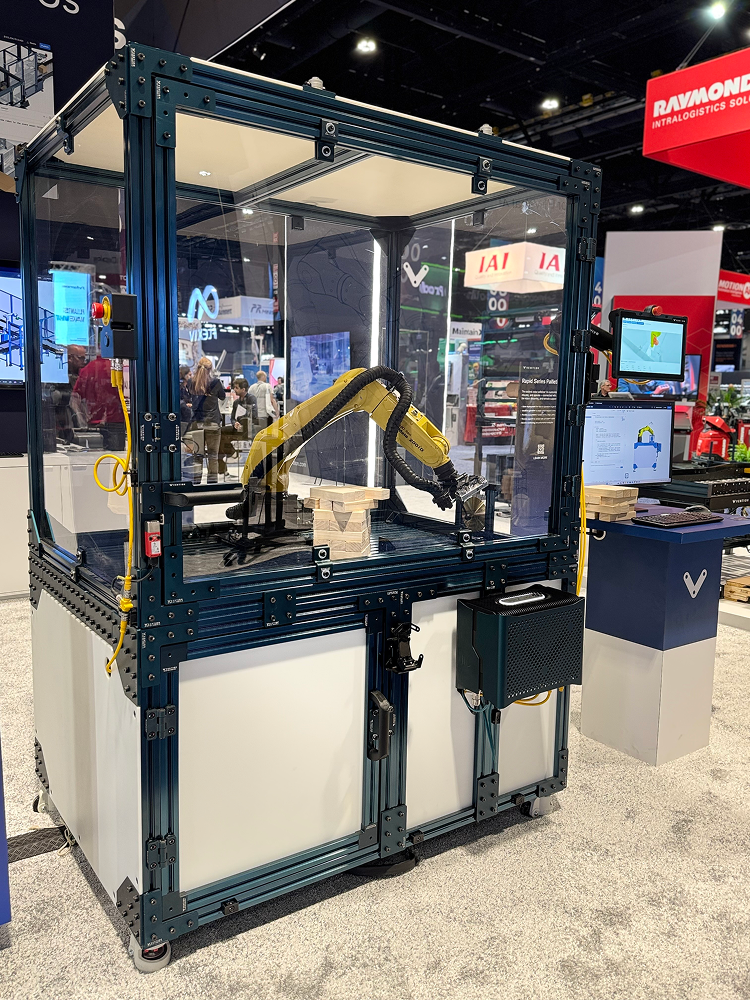
The industrial tending demo paired a FANUC LR Mate with Vention’s latest collision-free path planning, driven by NVIDIA’s FoundationStereo model handling autonomous path computation and motion generation. The demo highlighted the integration of industrial robots to the unified platform, ensuring that manufacturing leaders and machine shops can easily deploy all types of robotic cells. Visitors to the booth saw operators define a start and end target, then let the system scan the workspace, build the twin in the cloud, and compute the path between the two points without manual waypoint programming. Moving that compute-heavy work off local hardware is what makes it practical at scale. For teams that previously lost weeks reprogramming cells around new SKUs or fixtures, removing waypoint setup is the part worth watching.
Rapid Operator AI on a UR12e
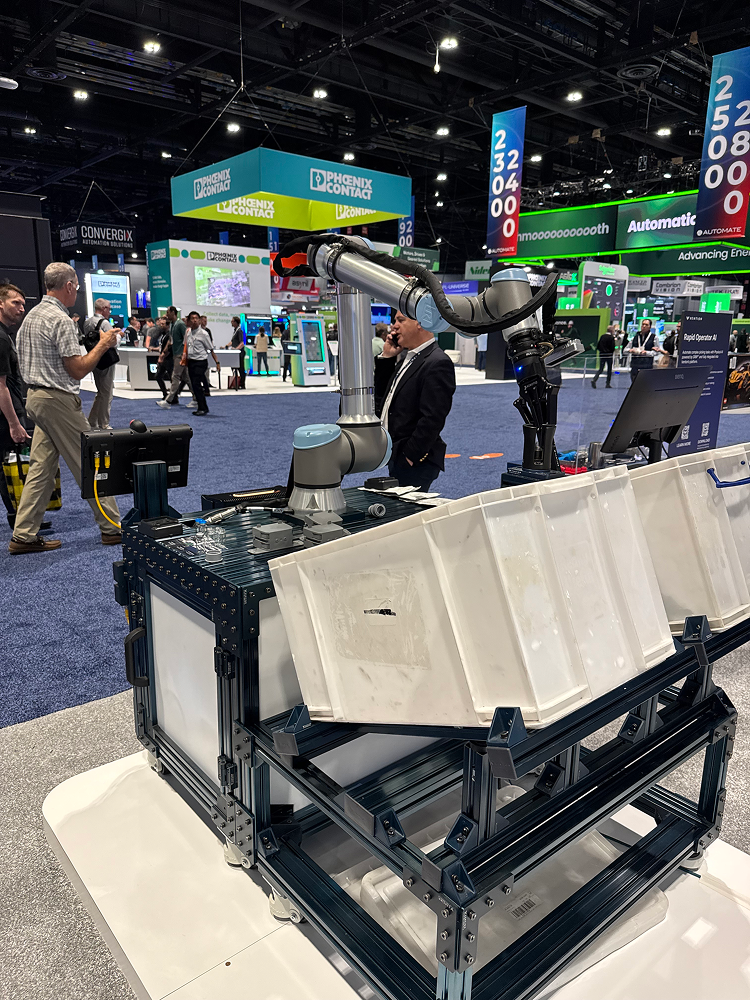
Vention’s deep bin-picking solution ran on a Universal Robots UR12e cobot with stereo vision and edge inference camera from Luxonis, the GRIIP™ pipeline, and NVIDIA Isaac foundation models. Visitors watched it pick from cluttered bins up to 24 inches deep, handling opaque, translucent, and transparent parts with real-time detection, 6-DoF pose estimation, and collision-free grasp planning. The hard part of production bin-picking has always been onboarding a new part without retraining a model. Here a new part could be introduced from a CAD file, which is what separates a controlled demo from something a plant can run across shifts.
An Overhead Range Extender in a Welding Application
A UR20 cobot mounted on an overhead 7th-axis range extender ran a live weld, giving the robot the span to work large parts in a tight footprint. The extender and four daisy-chained motors all ran on a single MachineMotion AI controller, the same cabinet-free architecture powering the rest of the booth. Welding was the showcase, but the setup reads as a pattern: the same overhead extension serves machine tending across stations, pick-and-place down a long conveyor, or assembly on oversized fixtures. Reach limits are one of the quiet reasons cobots get ruled out of bigger jobs, and this collaboration showed how they can take on large work without surrendering the floor space a fixed robot would claim.
The Latest Rapid Series Palletizer with FANUC CRX-30
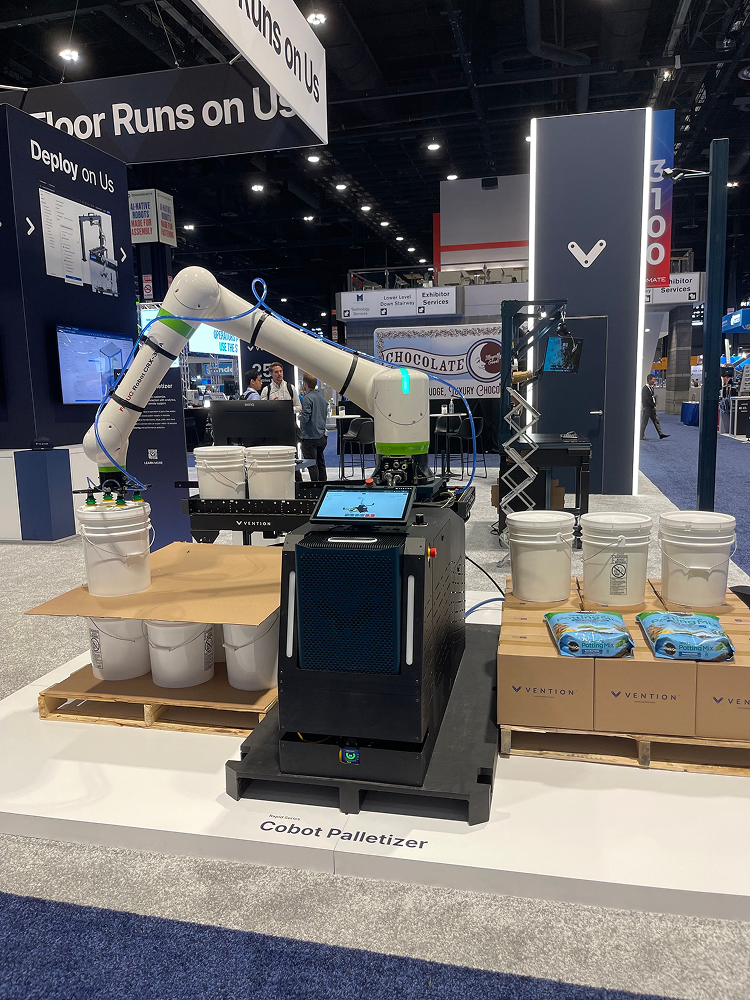
The end-of-line demo featured a FANUC CRX-30 cobot with Vention’s newest palletizer and an integrated conveyor ecosystem powered by MachineMotion AI, supporting up to 20 motors per controller. What drew people in was the touchscreen: visitors could build and adjust a pallet pattern on the spot, no code, and watch the cell adapt, with RemoteView and Remote Support showing how the system gets monitored and diagnosed after it ships.
A Modular Workstation and Factory Infrastructure Platform
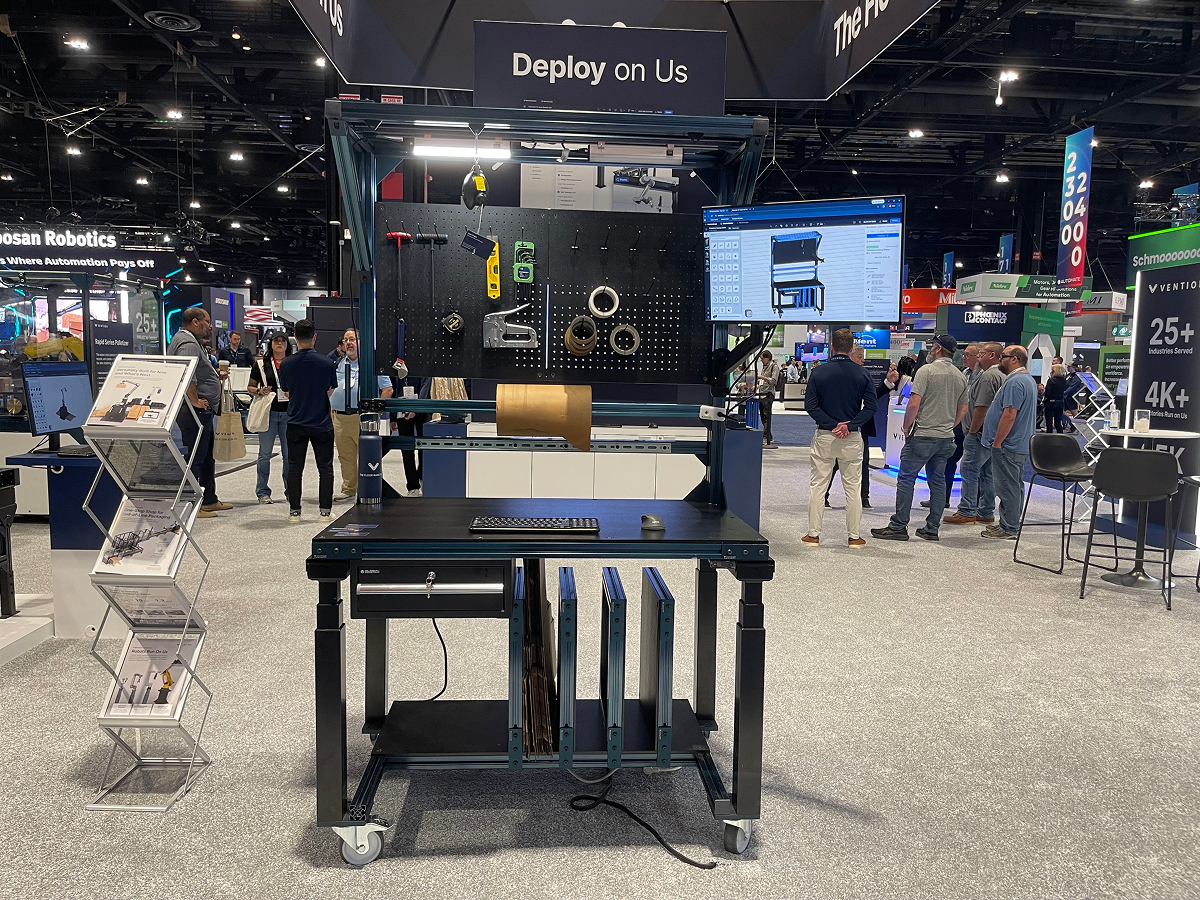
The last demo was the one that proves the platform point best. Workstations and carts do not look like cutting-edge automation, but in aerospace and defense and a long list of other industries, they quietly decide the flow of production. A workstation that can be configured to the work and delivered in days rather than specified over months means the manual stations stop being the bottleneck the automated cells have to wait on.
Unified Platform Experience and an Early Glimpse of Agentic AI
The booth also ran live demonstrations of Vention’s Manufacturing Automation Platform, walking visitors through the full Design, Simulate, Deploy, and Operate journey on a single software-defined stack. A cell could be designed in the free design tool from the largest ecosystem of plug-and-play parts, with a bill of materials updating in real time, then programmed, validated, and pushed to the floor without ever changing environments.
At Automate 2026, Vention also shared the first glimpses of agentic AI at the programming stage. At the platform experience section, visitors watched Claude generate a working application in Python using the Developer Toolkit, sync and push that application to the Vention cloud, and verify it in simulation before anything ran on real hardware.
The clear takeaway for visitors was that automation can now be written and revised by the same agentic tools developers already use for software, turning a chain of disconnected specialist tasks into one workflow a single team can own.
Send Us Your Parts: Testing Physical AI Beyond Pilots
Vention’s Send Us Your Parts initiative was the center of conversations at Automate 2026. Most manufacturers are still unsure whether Physical AI will work on their floor, with their specific parts, so the campaign let them bring real production parts to evaluate with Rapid Operator AI, testing the system against their own components rather than a curated demo set. For automation leaders weighing whether perception systems hold up on their actual SKUs, that hands-on validation builds far more confidence than a spec sheet.
Thought Leadership at Automate 2026: The Three Eras of Industrial Automation
Vention’s Chief Product Officer, Brendan Sterne, took the speaker stage at Automate to make the case that industrial automation has entered a third era. The hardware-defined era made every project a custom build around rigid PLCs. The software-defined era abstracted logic from hardware through cloud-native programming and digital twins, yet teams still spent months stitching vendors and tools together before a line could run. The next era in manufacturing will change that.
Sterne’s case for AI-defined automation is that unified hardware, software, and AI can collapse those timelines from months to days while reducing integration risk, drawing on real deployments where manufacturers stood up robotic applications faster and got systems performing reliably from day one.
Vention’s First Developer Workshop and the Launch of Developer Toolkit 2.0
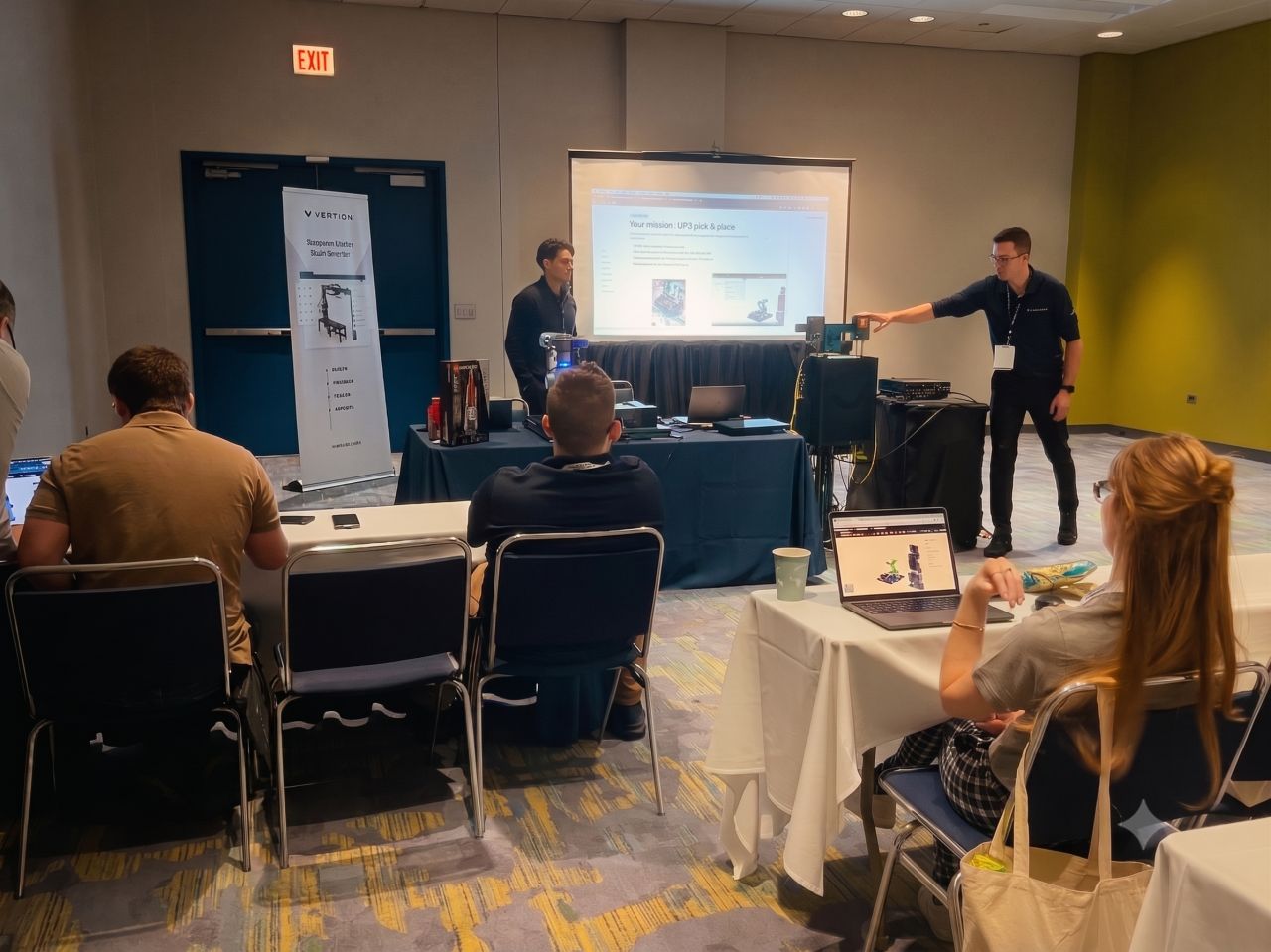
Automate also hosted Vention’s first Developer Workshop, a dedicated session that brought together developers and automation professionals for hands-on work on cloud-to-edge programming, MachineLogic workflows, and Python-based automation. The sessions reflected how much of modern automation now happens in code and configuration rather than wiring and fixed tooling, and how the people doing that work increasingly come from a software background.
The centerpiece of the activity was the release of the Vention Developer Toolkit 2.0, the updated set of tools for programming and extending automation on the platform. A versioned, openly documented toolkit aimed at integrators and developers reinforces the software-defined approach and lowers the cost of standing up repeatable, customer-specific automation.
Next at IMTS 2026: From Software-Defined to AI-Defined Automation
The biggest stories from Automate 2026 all pointed toward the same new normal: automation platforms expanding into industrial robots, collision-free motion planning moving to the cloud, simulation becoming a mainstay through the digital twin platform. Each chips away at the same bottleneck, the time, risk, and custom engineering it takes to get a cell from idea to running on the floor.
That is the vision Vention put forward at Automate 2026: the hard part of automation has shifted from building systems to deploying them. Automate was a snapshot of where that argument stands today, but the best is yet to come. With the foundation layer of the platform in place, manufacturing will see greater acceleration towards AI-Defined Automation. IMTS in Chicago this September will offer the first glimpses of what agentic AI can offer to manufacturing.
Whether you are scoping your first automated system or scaling a program across multiple lines, the team will be there to walk through how an AI-Defined platform can offer tangible benefits on the floor.
Not waiting until September? Book a demo with the Vention team to see these systems in action.


